

The Wolf in France: A Narrative Guided by Fear
by Chloe Destremau
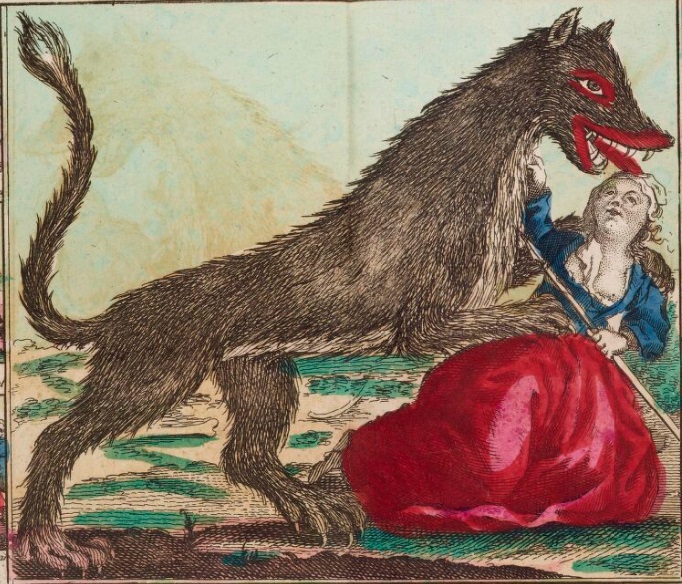
A couple of days ago, I stumbled across a news article reporting the encounter with a wolf in Brittany. « Probably a big husky, » I thought as I clicked on the link. It is not rare to mistake a large dog for a wolf, especially in an area that hasn’t seen a wolf in centuries. The video, recorded by a walker in the countryside, showed a large figure that looked like a wolf. And to prove to skeptics like me, it showed off its distinctive bouncy swagger as it trotted away, as if saying, I am no dog. Reactions to the sighting were mild: most commenters wrote to leave it alone, and only a couple called to hunt it. These reactions seem quite normal to us today, but they are an astonishing clash with the wolf’s historical perception. Few animals have occupied as complex and shifting a place in the human imagination as the wolf. Conservationists and casual wolf enthusiasts have worked hard to restore the wolf’s image in modern popular media and people’s minds. The reactions to the video are also surprising, since in other areas, like in the south of France, the wolf is still poorly perceived, branded as a relentless killing machine—if a sheep is killed, it is because of a wolf. Never mind the ridiculously small wolf population in France as a whole. It could not be a dog doing all the killings; only the big bad wolf is capable of such soullessness. But where does this perception come from? Why is the wolf so vilified?
The Wolf as a Species
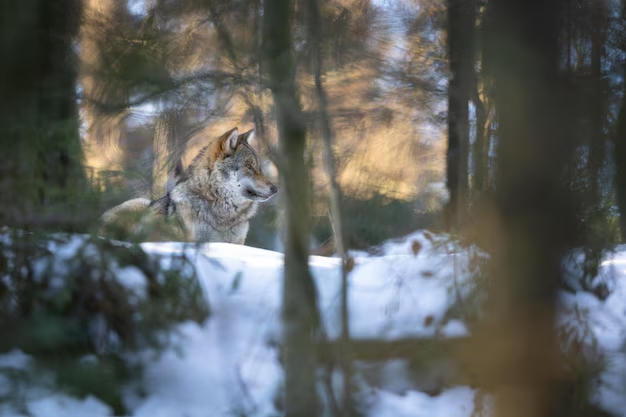
Before becoming a sheep-eating villain, the wolf is a species with a very specific functional role in its ecosystem. It is not only a top predator, but also a keystone species: a species that has a crucial influence on the overall functioning of the ecosystem by controlling the population of its prey. The best-known example is the reintroduction of gray wolves to Yellowstone National Park in 1995. We’ve since come to understand trophic cascades, how removing or restoring top predators can reshape entire ecosystems. In Yellowstone, eight wolves were reintroduced after being hunted to extirpation. Elk, which had reproduced in massive numbers, were now being hunted. Their population decreased significantly, reducing grazing pressure on vegetation and allowing regrowth. This recovery supported the return of beavers and a multitude of other species, in turn stabilizing riverbanks and reducing flooding and erosion.
Without the wolf, Yellowstone National Park would not look the way it does today. But unlike Yellowstone’s vast wilderness, Europe is a densely inhabited landscape—and has been for centuries, making the wolf’s ecological impact difficult to quantify and analyze. France’s wildlife has suffered greatly from anthropization, but we can only assume there was once a time when the wolf was central to ecological balance.
Remarkably, wolves in France were not reintroduced by conservationists, but rather reappeared on their own from the Italian Alps and have since slowly reconquered the land they once roamed.
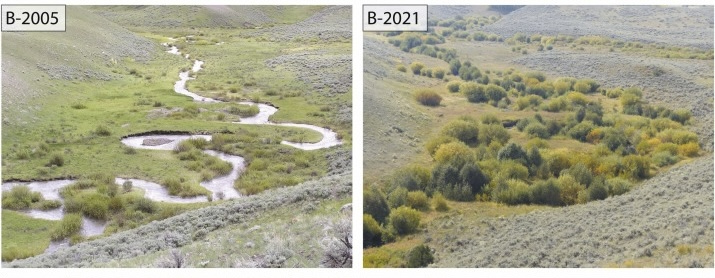
W.J. Ripple et al., The strength of the Yellowstone trophic cascade after wolf reintroduction, Global Ecology and Conservation (2025)
First Encounters
The wolf’s range and population density have changed over the last millennia, fluctuating in response to anthropic growth and development. At the end of Antiquity, forests covered the land and provided pristine habitat for small mammals, ungulates, and their predators, lynxes, bears, and wolves. It was a utopia for wildlife: endless wilderness and few human settlements. This meant that encounters with wolves were sparse and unlikely.
But during the Middle Ages, something changed—the need to develop the land for the benefit of human settlements became a strong incentive for people to enter the forest. There, they used the rich oak woodland to feed their pigs, fattening them up on the nuts of the trees. Pigs, naturally headstrong, were capable of defending themselves against any curious approaching wolf. The wolf, therefore, was scarcely regarded as a threat to livestock. People still feared it, but only because of the natural fear of a predator one can be expected to have.
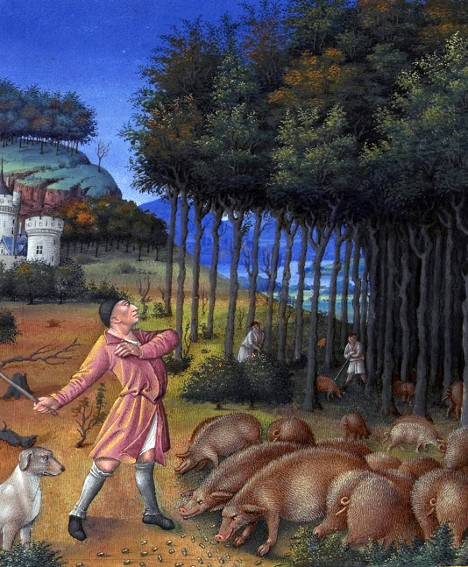
Les usages de la forêt, Détail des Très Riches Heures du duc de Berry (XVe)
First Perception
Depictions of the wolf in literary texts and oral stories have varied over time, depending on the wolf’s distribution in France and its encounters with human settlements.
One of the most famous medieval wolves is Ysengrin, the gullible and brutish foil to the cunning fox in the collection of stories known as the Roman de Renart (Reynard the Fox in English) written around the 12th and 13th centuries. Ysengrin suffers repeated humiliation because of his foolishness and stupidity. One example is the story of Renart and Ysengrin who go fishing. Renart explains to Ysengrin that, to catch the fish, he must attach a bucket to his tail and wait immobile for a couple of hours for the fish to enter it. Ysengrin does just that. But of course, the ice freezes, trapping Ysengrin, while Renart pretends to sleep. A villager arrives on the scene for a hunt; Renart flees, and the hunter ends up cutting Ysengrin’s tail.
Here, we have a tale that transforms the scary predator into an object of ridicule, both derogatory and comical, which may translate the need for shepherds to conquer the fear of the predator. We cannot fear what we find ridiculous, correct?
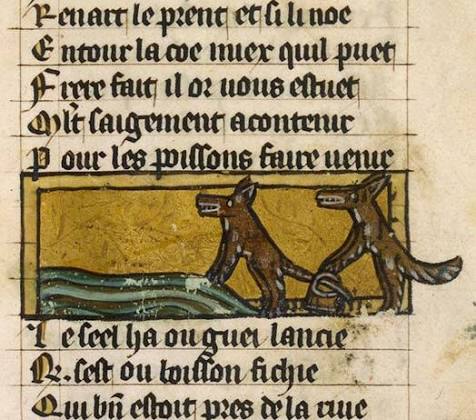
Renart (right) fixing the bucket to Ysengrin’s (left) tail, Roman de Renart.
La Chute
However, with economic growth from the 12th century onwards, the landscape began to change. With clearcutting forests, expanding villages, and building towns, the forests shrank considerably. Even areas like marshlands, riverbanks, and high mountain ranges were populated and cultivated. In some fragile areas, this led to devastating effects on the ecosystem’s biological complexity. In the surviving woodlands, now reassigned to the lower class, small dwellings were built for loggers, hunters, and peasants. Raising pigs could no longer be sustained and was replaced by a gentler creature—the sheep.
The forest, suddenly, stopped belonging to the wolf. The occasional intruder became the sovereign, changing the land as it wished and taking away the wolf’s food and shelter. Starving, the wolf had no choice but to step out of the woods.
Wolf attacks suddenly increased. Court documents reveal growing tensions between shepherds and landowners. The loss of even a single sheep could ruin a herder. What’s interesting is that historical and statistical records suggest that wolf attacks on livestock were relatively rare: roughly one sheep in a hundred per year. We may be missing data, unrecorded wolf attacks, or relevant archives may have been lost, which could explain the disparity between what the data shows and how people reacted. Regardless, fear trumped rationale, and so the concern to protect livestock systematically opened the way for a massacre which would lead, in the following centuries, to the extirpation of the wolf.
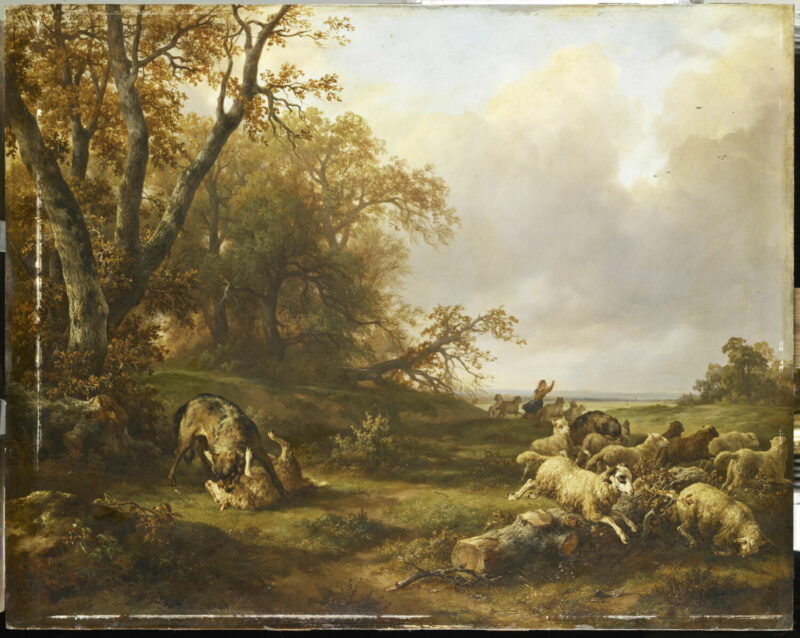
Wolf eating sheep, Jacques-Raymond Brascassat (1845)
By the Carolingian era, the animal’s eradication was no longer a matter of practicality, but an assertion of order. The forests belonged to the crown, and the wolf, by extension, became a rival to the king. Hunting wolves became popular among the nobles and royals; it was rather lucrative, and entire communities participated. Charlemagne’s « louveterie » institutionalized wolf hunts across royal forests, both as a duty to protect the land and its game, and as a reaffirmation of faith. Established in 1308, the title of Louvetier du Roi designated those responsible for leading royal wolf hunts, carrying privileges and duties that evolved over the centuries.
The French Kingdom at the time was far smaller than the country we know today. Rapid clearcutting of forests created a habitat incapable of sustaining large wolf populations. Archives record several hundred to a thousand wolf pups hunted each year during the 13th century—numbers that are unimaginable today.
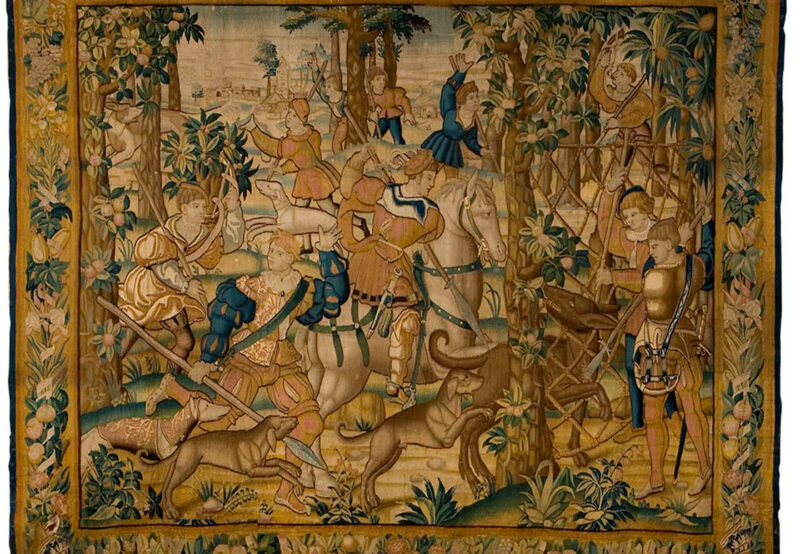
Wolf Hunt tapissery (1530)
The Wolf as a Villain
In parallel, as the wolf became a bigger threat, it entered the anthropic currents of culture via religion, literature, and folklore. The Church’s doctrines contributed to the fundamental shift in man’s perception of nature and wildlife, and, subsequently, were instrumental in shaping the wolf’s demonic identity. As early as the 4th century, Saint Ambrose, a bishop of Milan, had declared that « the wolf was the devil », condemning henceforth the wolf in religious allegories. But it is later, with the New Testament, that the « big bad wolf » truly took shape in allegorical imagery: the faithful as the sheep, God their shepherd, and thus, the wolf as the predator, the villain, one who brings temptation, chaos, and heresy. The Gospel of Matthew parallels false prophets as wolves disguised as sheep. And in sermons, it was no longer a mere predator but a servant of the Devil, walking among the faithful as Satan prowled for souls. To kill the wolf was to vanquish the devil.
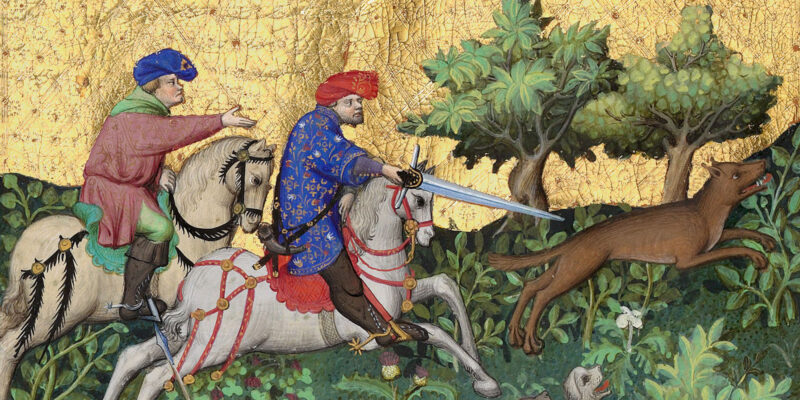
Wolf hunt (1408/1410)
During the Hundred Years’ War and the Black Death, wolves proliferated. Depopulated villages and abandoned fields became ideal habitat. Chronicles like the Journal d’un Bourgeois de Paris describe gruesome scenes: wolves digging up corpses, roaming the streets, and even entering Paris to attack people, dig through cemeteries, and eat abandoned children. The infamous tailless wolf “Courtaut” terrorized the city in 1439 before being killed and paraded through the streets in a wheelbarrow.
As the wars raged on and diseases filled cemeteries, wolves grew accustomed to human flesh. The beast of Gâtinais, a human-eating wolf, terrorized villages around Paris during Anne of Austria’s regency under Louis XIV. It was eventually thought to have been successfully killed by the king’s Grand Louvetier, but of course, the beast wasn’t just one wolf; it was an ensemble of starving wolf packs.
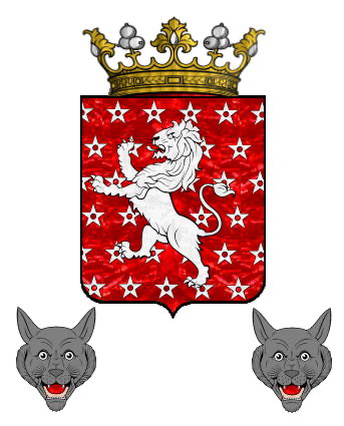
Grand Louvetier, François Gaspard de Montmorin (1655–1701)
Other reports appeared in the Loire Valley, particularly in the surroundings of Orléans and Tours; wolves eating men, women, and children as typhoid and famine ravaged villages. Later, the Beast of Gévaudan would echo these terrors, as between 1764 and 1767, dozens were killed in southern France, and a handful of wolves became, through panic and press, one monstrous legend.
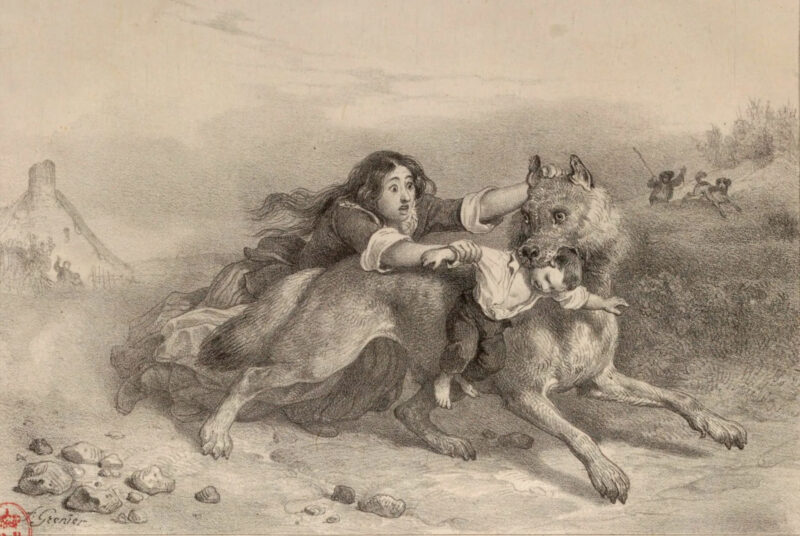
Jeanne Jouve tries to snatch her child from the jaws of the Beast (Gévaudan). Engraving by François Grenier de Saint-Martin (1765)
The Wolf as a Supernatural
Reports of man-eating wolves spread. Criminals began to wear wolf pelts to terrorize villages for coin. Superstition rose; we were at the peak of witchcraft and witch trials. Suddenly, the myth of the werewolf—already present in folklore—gained a new dimension in the countryside during this era of famine, plague, and war. The Church had long dismissed the notion of an actual transformation from man to beast—as only God possesses the ability to create—framing it instead as an illusory metamorphosis born of demonic influence. Yet superstition took hold nonetheless.
The werewolf lost its supernatural form and gave way to a wave of trials in the 15th century. It was commonly thought the fur was hidden beneath the skin; thus, the accused were first severely interrogated and, if found guilty, were burned at the stake. The most notorious case is that of Gilles Garnier, condemned to the stake for murdering and devouring children. In his confession, he spoke of a dark figure who had given him an ointment said to transform him into a wolf (a demon? satan himself?). In the Jura mountains, judge Henri Bohguet, renowned for his witch trials, claimed to have sent six hundred werewolves to the stake. Throughout France, hundreds of werewolf trials were held until they were finally abolished in 1682.
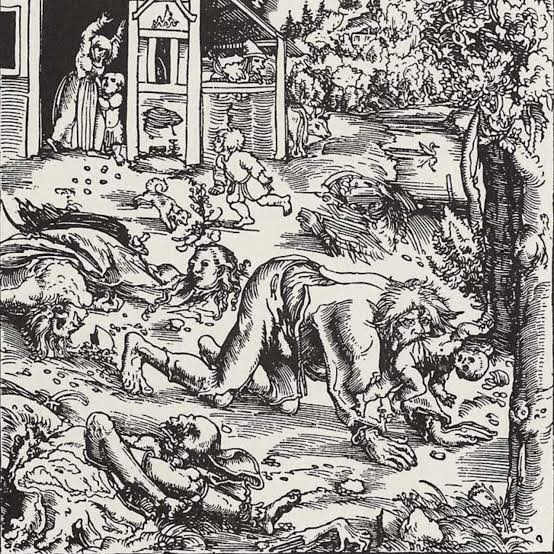
Gilles Garnier, the werewolf of Dole (1574)
The Wolf as a Symbol
By the seventeenth century, the wolf shifted from reality to literary allegory. In Little Red Riding Hood, the wolf retained its predatory nature but served a moral function, warning against disobedience and danger in the guise of innocence. In the French poet and playwright Jean de La Fontaine’s fable Le Loup et l’Agneau (the wolf and the lamb), the animal was used as an instrument of social critique, illustrating the abuse of power and injustice during Louis XIV’s reign toward the lower class. In the fable, the wolf tries to justify its desire for power with rationale. A power that stems, by nature, from its strength as a predator. Whatever the lamb counters, as logical and factual as it may be, is refuted on the basis that it is a weak, prey animal, and therefore must yield to the wolf. My word goes, “because I can eat you” type rhetoric, and that’s exactly how the fable ends: with the wolf eating the lamb. Fontaine denounces the all-powerful monarchy and its hypocritical justice system built on the foundation of force. This fable is taught to French students today in schools—I, myself, can recite it by heart still to this day. So, through fable and folklore, the wolf’s image persisted, no longer a living threat but as a moral and political symbol.
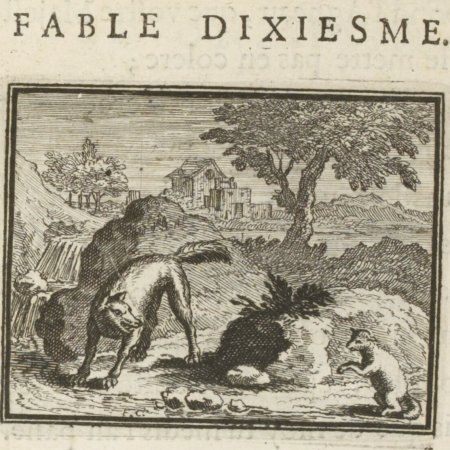
Le Loup et l’Agneau, François Chaveau (1668)
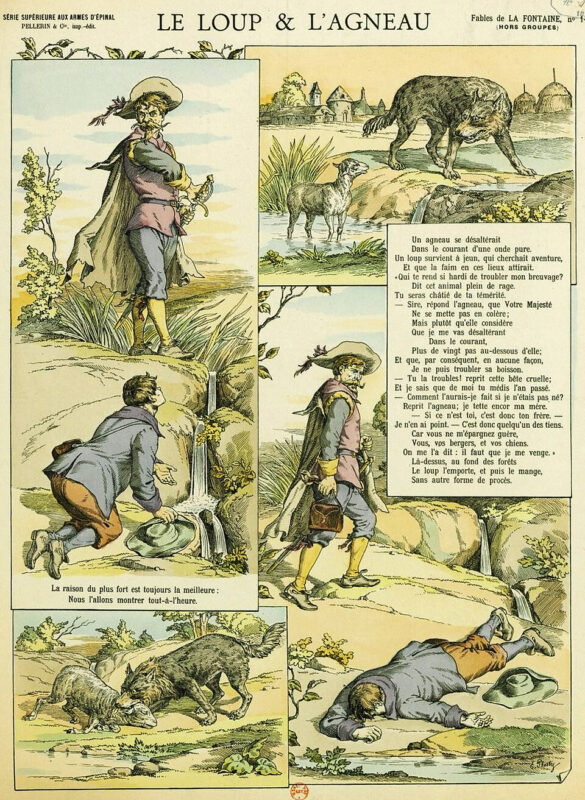
Print by E. Phosty depicting Jean de La Fontaine’s fable The Wolf and the Lamb (Epinal, published by Pellerin & Cie, 1895).
The Last of the Wolves
The wolf, fed by war and famine, flourished. That is, until the French Revolution. Ridden of the monarchy, the newly established administration homogenized hunting rights and made the destruction of predators a national affair. The louveterie of the king ceased to exist and was instead reorganized, where administrative officials coordinated battues, distributed bounties, and compiled reports. With gunpowder becoming more readily available, what had been a local affair turned into a bureaucratic campaign of extermination. With no more habitat left, and its image defamed, slandered, and tarnished, the wolf was swiftly extirpated in the following century, with the last being killed in 1940.
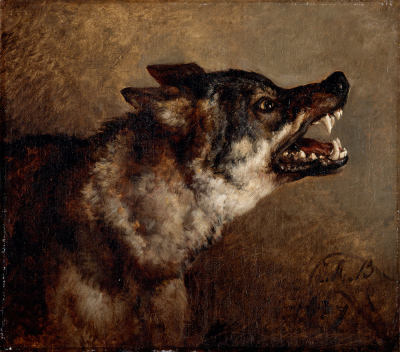
Wolf head. Jacques Raymond Brascassat (1837).
Conclusion
Once a natural presence across France’s forests, the wolf has been exterminated, defamed in literature, religion, and among the royals, transformed into a supernatural creature, accused and demonized for its predatory nature. The wolf has not had an easy time. Most predators don’t; like the mountain lion and the bear, the wolf has been condemned for its biology. And yet, it occupies an incredibly important role in the ecological sphere. I do believe that once we understand the animal for what it is, we let go of the fear.
The wolf spotted in Brittany would’ve, once upon a time, been shot and paraded through the streets. And now, despite its centuries-long slander, the wolf is left alone, at last, to roam the land it once dominated.
 About the writer (photo): Chloé Destremau, pictured right during our one-hour Friday morning, Cassis calanques cruise on our Provence Tours, is a freelance writer and our team marine biologist for our Provence Tours, and the daughter of Christy Destremau, founder and owner of France Off the Beaten Path Tours. Chloé joined the France Off the Beaten Path Guiding Team in 2025 after completing her Masters in Marine Science at the University of Marseille.
Complete 2027 Schedule of Tour Dates & Prices
- Plan ahead – Check out available 2027 tour dates for all of our destinations in France – check out ALL of our 2027 tour dates
Email Questions or Confirm Availability
- Contact us at christy@traveloffthebeatenpath.com to request space availability and/or ask questions.
- Message us on WhatsApp at +1.717.683.2827