

The Companion Dog at the French Court
by Chloe Destremau
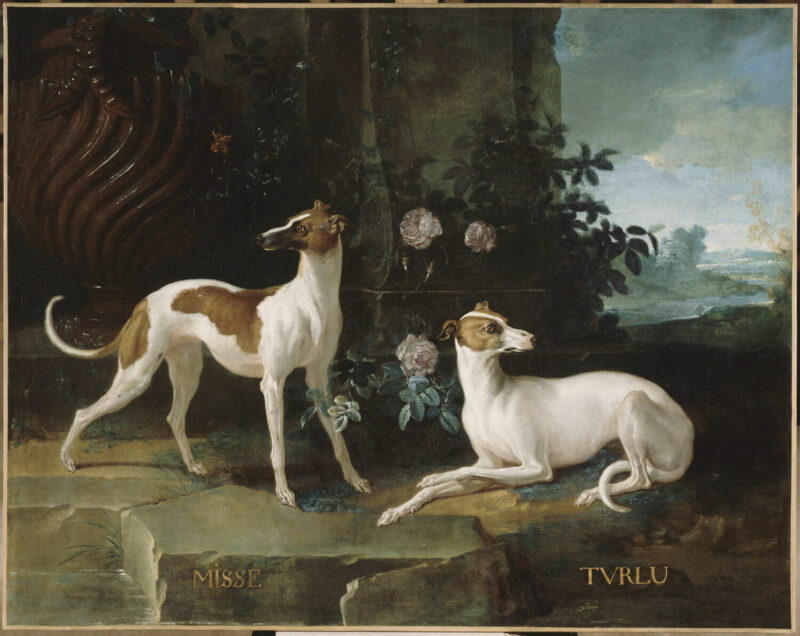
Misse and Turlu, Louis XV’s greyhounds by Jean-Baptiste Oudry (1725)
The Companion Dog at the French Court
Most of us love dogs. Many of us live with them, and for a lot of people, life without them is almost impossible to imagine. They’ve become an integral part of our everyday lives: we care for them attentively, feed them high-end food and patisserie-made biscuits, buy them more toys than they could ever need, and spend far too much money on dog beds they inevitably snub for the couch.
It’s easy to think of this kind of devotion as something distinctly modern—that in the past, dogs were purely utilitarian animals, valued only for the jobs they performed, while today we’ve transformed them into spoiled companions. But the reality is far more nuanced. In fact, if we look back a few centuries, we find that French kings and their courts already pampered and doted on their dogs in ways that feel strikingly familiar.
The Dog as a Companion Animal
During the medieval period, a dog’s purpose defined the care it received, who owned it, who cared for it, and how it was perceived. Dogs were found in every social class both in urban and in rural environments. In the countryside, they served primarily as working animals, herding livestock or guarding property. In cities, large numbers of stray dogs roamed the streets, while others belonged to tradespeople such as butchers and bakers, who could feed them easily and employ them as guard animals. By the 18th century, it is estimated that between fifteen and eighteen thousand dogs were found in Paris. However, it was mainly among the upper classes that dogs entered the domestic sphere and established themselves as true companion animals.
Few dog breeds existed in France at the time, and most were usually imported from abroad. The Cavalier King Charles came from England, the Bolognese breed was imported from Italy, while spaniels came from Spain. White curly-coated dogs, the « bichon », appeared during the Renaissance in Italy, while the flat-coated variety came from Greece.
While hunting dogs were selectively bred for desirable hunting traits, dogs to be kept as pets were selected based on their size and soft tempers. Indeed, companion dogs were not exactly defined by their breed but rather by their small size, as they needed to be light enough to be carried around by their owner. Smaller dogs would thus be selected for breeding, and their puppies would be underfed to stunt their growth.
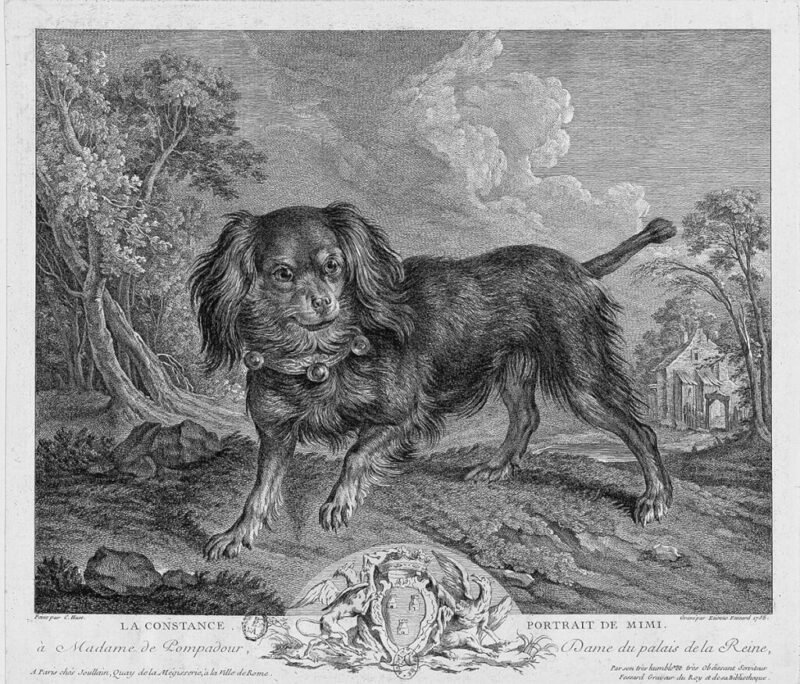
La Constance, Portrait de Mimi, Madame de Pompadour’s spaniel, by Étienne Fessard (1758)
Because the companion dog seldom went outside and served no purpose other than companionship, contrary to the hunting dog who served a clear purpose, they were usually kept by women and clerics, groups of people who were not associated with the outdoors. Indeed, the outdoor activities—fighting and hunting—belonged to married men, particularly those of the nobility. As a result, it was generally frowned upon for men to keep small companion dogs. Dogs functioned, in part, as extensions of their owners’ identity, reflecting desirable social qualities. For men, especially those who were unmarried or expected to embody martial virtues, it was far more acceptable to own a large working dog—one that symbolized strength, loyalty, and fierceness.
For women, however, it was a sign of prestige to have a lapdog, and they were thus very popular among the aristocracy and small bourgeoisie. For example, Versailles was crawling with animals; courtiers and royals were accompanied by their dogs in their day-to-day lives. Some even complained there were more dogs at court than children. But once again, it was mainly the women who assumed the lapdogs. Mistress to Louis XIV, Madame de Pompadour was undeniably a dog lover and had multiple etchings produced of her spaniels. She may even have made some herself, though the art has been lost to time. Princess Palatine, second wife to Philippe I, Duke of Orléans, Louis XIV’s younger brother, kept dozens of spaniels. Marie-Antoinette famously kept pugs, then popular at the English court.
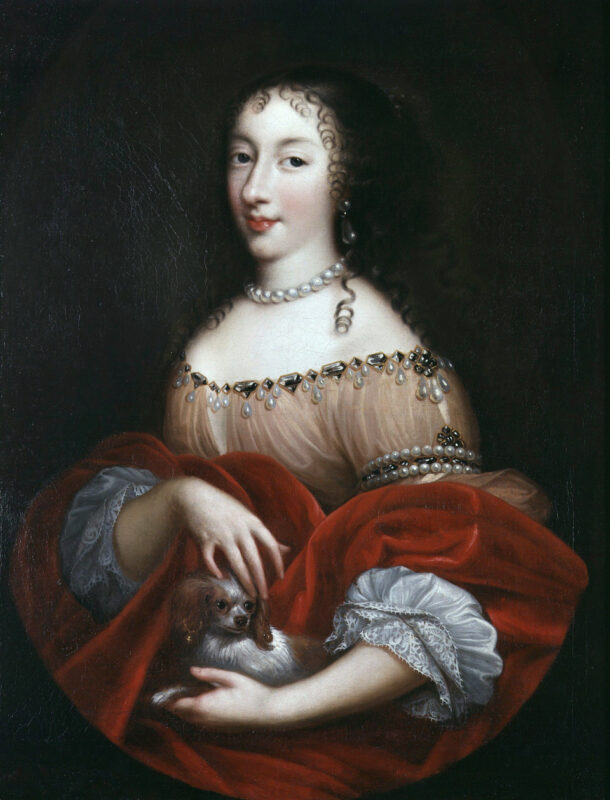
Henrietta of England, Duchess of Orléans, first wife to Philippe I, Duke of Orléans,
little brother of Louis XIV, by Pierre Mignard (1665-70).
*Note the earings on the spaniel.*
Symbols of Status
For the aristocracy, dogs were not only companions but also visible symbols of status. To distinguish their animals from those of the lower classes and display their wealth, elites adorned their dogs with lavish accessories. These objects played an important role in expressing status within the culture of vivre noblement (“living nobly”).
Dog collars, for instance, were crafted from fine leather or luxurious textiles and richly ornamented with heraldic arms, bells, escutcheons, personal mottos, and intricate embroidery. Historical records show that Louis XI commissioned a gold collar for his greyhound, lined with crimson velvet and set with twenty pearls and eleven rubies, costing 245 livres. To put the cost in perspective, this amounted to roughly seven years’ worth of salary of Louise de Savoie’s skilled manuscript illustrator.
Royal women also ensured their dogs expressed their identity and power. When Anne of Brittany married Charles VIII in 1491, she kept a kennel of 24 dogs—nine of them greyhounds—and each wore matching black velvet collars adorned with dangling ermine paws, a direct reference to the heraldic symbol of her duchy. Black was the new fashionable color; just as her courtiers were dressed in black velvet, her dogs were too. Note that, at the time, velvet was made from silk, an incredibly costly fabric. Similarly, Charles IX, who kept 36 small greyhounds, had red and green velvet collars for all of his dogs.
Even later monarchs continued this practice of symbolic display. The dogs of Louis XVI wore collars fitted with silver plates engraved with the words “Je suis au Roy” (“I belong to the King”), clearly marking both ownership and status.
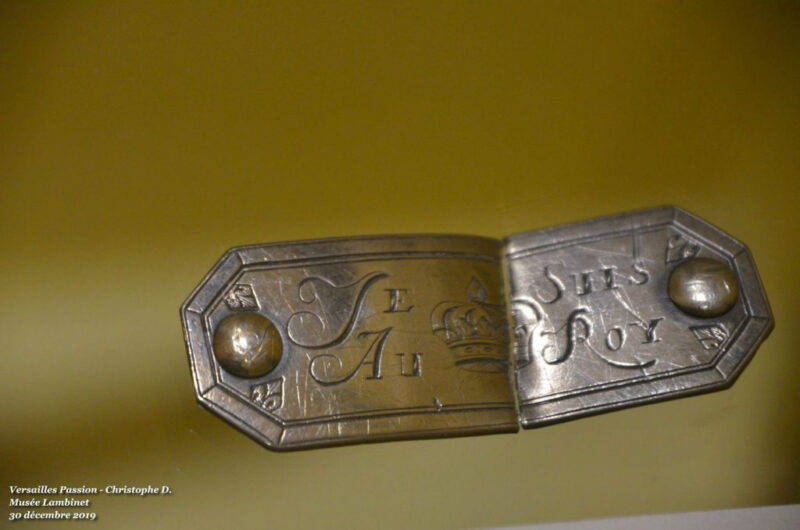
Silver plate for Louis XVI’s dogs.
In addition to collars, royal dogs were also sometimes dressed in garments, jackets, and woolly sweaters. Records show Marie de Clèves, the mother of Louis XII, ordered five jackets for her greyhounds. Charles VIII’s court mentions a bright green woolen jacket made for a small lapdog during the winter.
Dogs also had specialized furniture. After being cleaned and dried upon returning indoors, pet dogs, if they did not hop on their owner’s beds, rested in their own custom dog beds, often in the form of cushions. Numerous records attest to such objects: Louis XI, for instance, had cushions made of deer fur for his small dogs. The royal journals of Louis XIV note bench-style dog beds, over four feet long, enough to house two dogs, usually pointer-sized dogs. In the 18th century, dog beds diversified in size, shape, and color. Louis XV’s daughters had ornate kennels for their dogs; whitened wood with intricate golden sculptures.
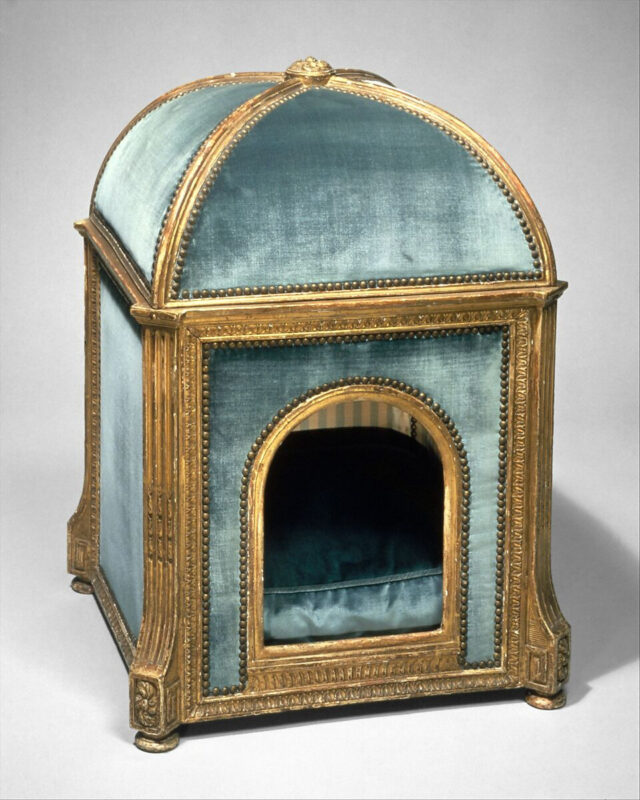
Dog kennel for Marie-Antoinette by Claude Séné (1775-80)
Diet further reflected the distinction between working and companion animals. Hunting dogs were typically fed greasy, meat-based soups with bread. They also received bread several times a day and even during hunts. Greyhounds, distinguished for their elegant appearance, were also sometimes rewarded with scraps from the hunted animal.
Companion dogs, by contrast, enjoyed a far more indulgent diet. They were fed from the table as illustrated in Ronsard’s poem about Charles IX’s dog, Courte, and generally lived in far more relaxed conditions than their hunting counterparts. By the sixteenth century, they even had a dedicated baker—the boulanger des petits chiens—who prepared small loaves for them. As a result of this rich diet and the affection they received, companion dogs were often overfed and overweight.
So, companion dogs were typically of small size, of various types and breeds, were adorned with lavish collars, had their own custom dog beds, were granted tasty diets, and were mainly kept by women. But what about the kings?
Kings and Their Dogs
Most French kings were avid hunters and, as such, maintained large packs of hunting hounds. However, relatively few kept dogs within their private chambers, even if their queen did. A few notable exceptions nevertheless stand out.
King Henri III, rather a scholar than a hunter, kept a large pack of lapdogs in his company. Accounts report he spent around 100,000 écus per year on his dogs. Among his favorites were spaniels, especially small white, long-haired dogs known as “petits chiens de Lyon,” resembling the modern Bichon Frisé.
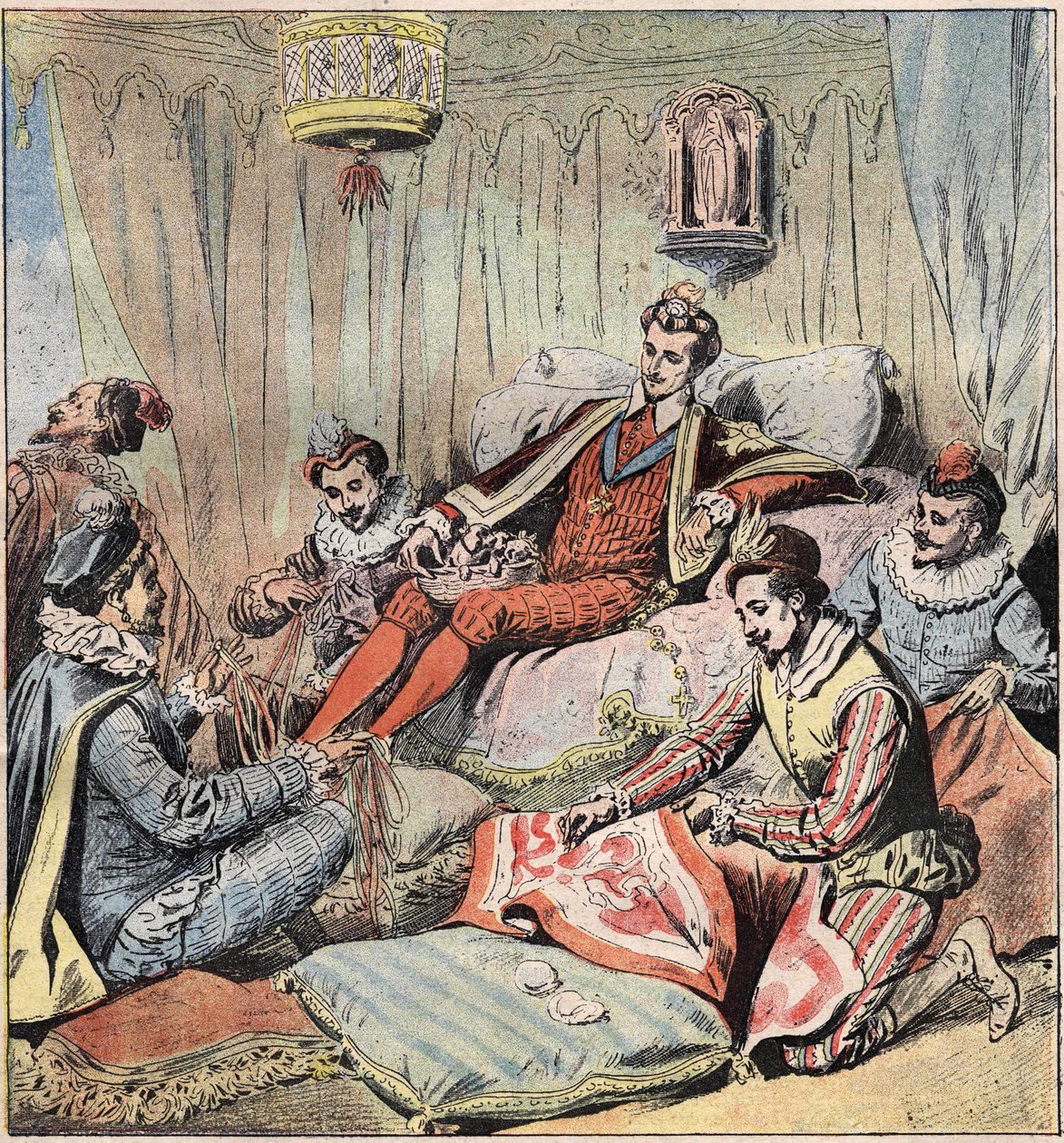
Henri III was widely regarded as extravagant and eccentric. For example, Henri III received his ambassadors holding one of his dogs in a satin basket tied around his neck by a ribbon. When he traveled, he usually brought his lapdogs with him. In 1586, on a journey to Lyon, he reportedly brought with him as many as two hundred dogs, organized into groups, each overseen by a governess and accompanied by a pack horse.
Such behavior, excessive even by modern standards, attracted considerable criticism from contemporaries. More troubling to observers was the king’s reputed habit of appropriating dogs that caught his eye in Paris, often even taking them from convents and nunneries.
Henri III’s extravagance for dogs became a powerful tool in the hands of his political opponents, particularly among Huguenot writers, who portrayed it as a sign of weakness and effeminacy, reinforcing claims of his unfitness as a king.
Keeping a companion dog as a king was rarely well perceived, and rarely recorded in the history books as something notable. Historians have traditionally emphasized military achievements, architectural patronage, and political influence, leaving the personal relationships between rulers and their pets largely overlooked.
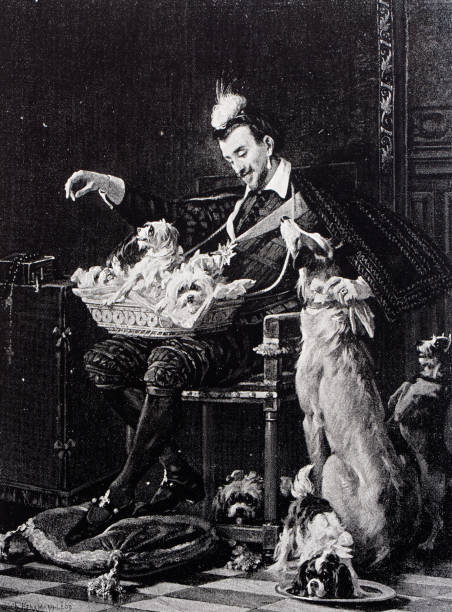
Henri III and his dogs by Hermann-Léon. Note the dog basket full of lapdogs.
In contrast to Henri III, Louis XIV firmly established the legitimacy of royal dogs within the historical record. Louis XIV was an avid hunter, practicing various forms of hunting with hounds, falcons, and firearms. But he preferred hunting with guns, and his pointers were his favorite dogs among all hunting animals. The Great Kennel of Versailles housed three hundred hunting dogs for all different types of hunting.
But Louis XIV loved his pointers so much that he kept his favorites with him in his private apartments. For Folle, Mite, Bonne, Nonne, and more, Louis XIV converted the first antechamber of his headquarters into a Dog Room. He usually kept seven to eight dogs with him at a time. Every evening, after the couché public—the public ceremony in which the king retires to his bedchambers—Louis XIV went to the Dog Room to feed them biscuits prepared by his own kitchen staff.
He even had special servants for his dogs’ care: a Capitaine des Levrettes, who was in charge of the hounds’ overall health; le Premier Maître d’hôtel, who was in charge of giving them treats; l’Officier de Bouche, in charge of distributing the treats to the Premier Maître; a pâtisser, who baked the treats; four valets who took care of the hounds; two guards for the smaller dogs.
Louis XIV cared so much about his dogs that, in 1702, he commissioned François Desportes, then emerging as one of the leading painters of the period, to paint portraits of his dogs. Desportes accompanied the king on his hunts, sketching spectacular scenes on scrap paper that he later retranscribed on canvas. The finished paintings were sent to the Château de Marly, the private residence of Louis XIV. These works contributed to the rise of animal portraiture as a recognized genre and helped legitimize the presence of dogs—particularly for men—within elite culture.
While Henri III was widely unpopular and consequently the target of intense defamation and his attachment to dogs was heavily criticized, Louis XIV played a key role in normalizing the keeping of dogs among male elites. Although he favored larger hunting dogs rather than small lapdogs, he treated them with the same intimacy and care women gave their lapdogs.
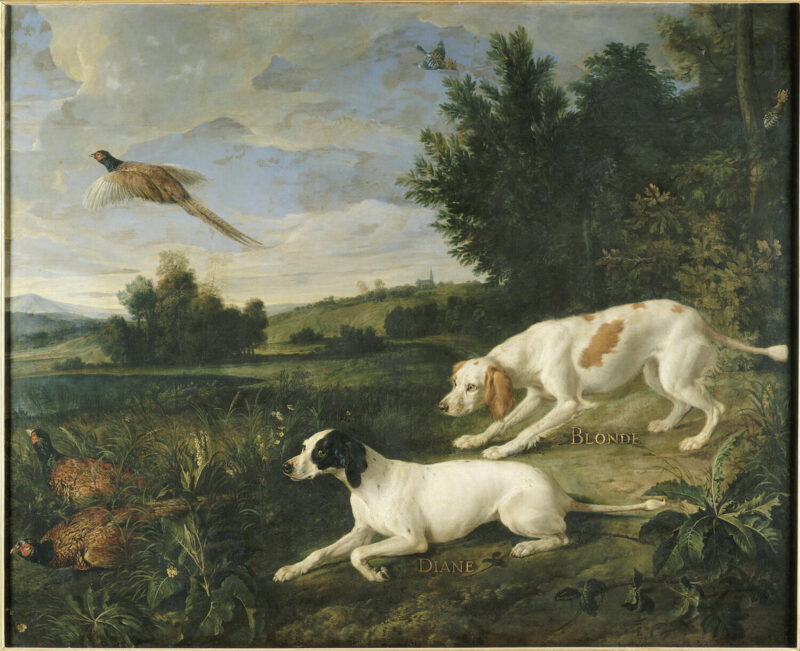
Diane and Blonde, dogs from Louis XIV’s pack, hunting, by François Desportes (1702)
His successors continued keeping dogs as companion animals. While Louis XV kept hunting dogs, he preferred greyhounds and spaniels imported from England. Louis XV continued to commission François Desportes for dog portraits, though later he also commissioned Jean-Baptiste Oudry to paint his dogs for his personal residence, the Château de Campiègne. It is said he often sat during the painting sessions, watching the artist paint the portraits of his dogs. He liked Oudry’s paintings so much that he continued to commission him for other various paintings for the menagerie of Versailles, even offering him headquarters at the Louvre and a studio in the Tuileries.
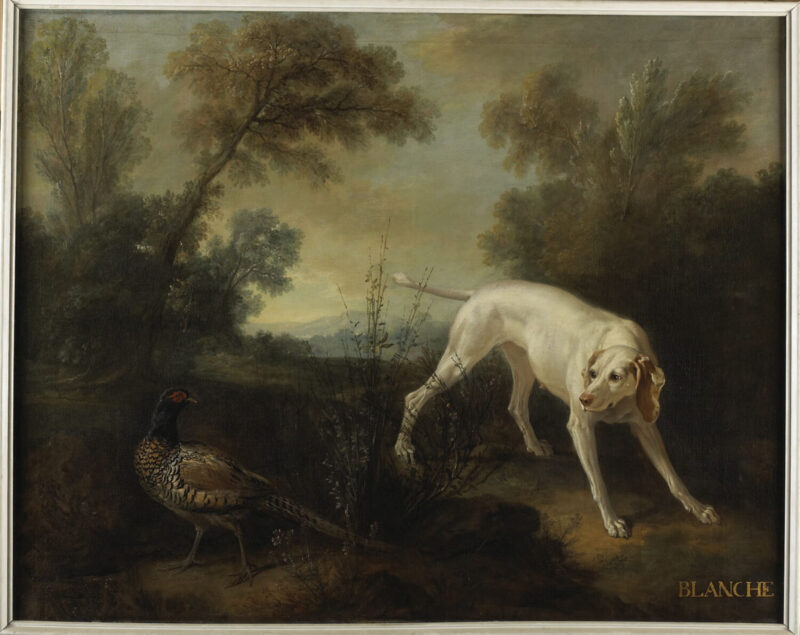
Blanche, a dog from Louis XV’s pack by François Desportes (1727)
Conclusion
Dogs have been man’s best friend and most loyal companion for thousands of years, and the French royal court was not immune to keeping dogs as pets. Originally prestigious pets, valued as symbols of wealth and mostly kept by women, dogs gradually became beloved companions across all social classes and genders.
So next time you consider buying an expensive dog collar or bed, remember the kings and queens who lavished their dogs with pearls, golden ornaments, custom-made furniture, and even spent extravagantly on their care and commissioned portraits!
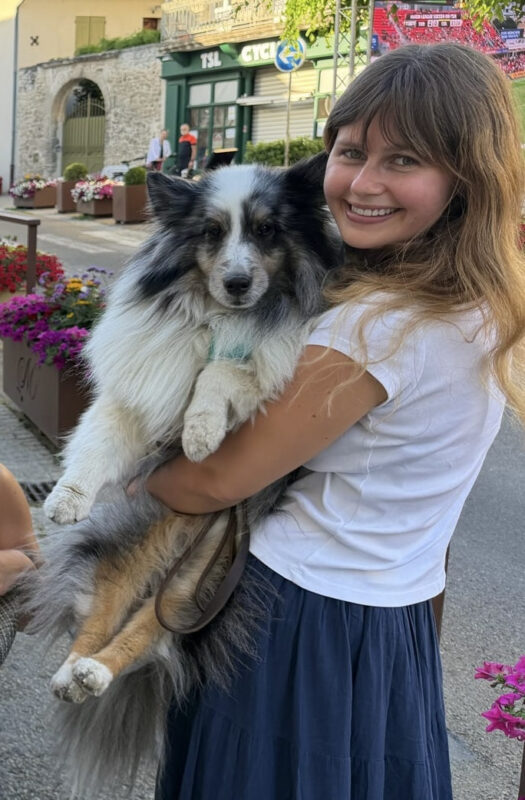 About the writer (photo): Chloé Destremau, pictured with her dog Nova at dinner in Provence, is a freelance writer and accomplished marine biologist, and the daughter of Christy Destremau, founder and owner of France Off the Beaten Path Tours. Chloé joined the France Off the Beaten Path Guiding Team in 2025.
Complete 2027 Schedule of Tour Dates & Prices
- Plan ahead – 2027 dates filling fast – check out ALL of our 2027 tour dates
Email Questions or Confirm Availability
- Contact us at christy@traveloffthebeatenpath.com to request space availability and/or ask questions.
- Message us on WhatsApp at +1.717.683.2827