


Silk : a Cocoon of Many Fates
by Chloe Destremau
It is said that silk was discovered when a silkworm cocoon fell into Empress Hsi Ling Shi’s tea. The hot water would’ve freed the filaments and stuck to the Empress’ hand. Instead of pulling out a cocoon, a single thread would’ve unraveled from her hand—a thread that would weave civilizations together in the following centuries.
There is, of course, no certainty that Empress Hsi Ling Shi’s tale is how silk was discovered. But we know that sericulture—the process of producing silk by rearing silkworms—originated in Neolithic China.
Isothermic, resistant, soft, and shiny, silk is an elegant and refined textile appreciated across the world. While it is easily accessible today, it was once a rare and noble commodity. Sericulture was no easy task—cultivating mulberry trees, raising silkworms, collecting the cocoons, and reeling the thread—it was a process that demanded time, skill, and the right environmental conditions.
While the fabric was readily traded worldwide, sericulture spread much more slowly to the West.
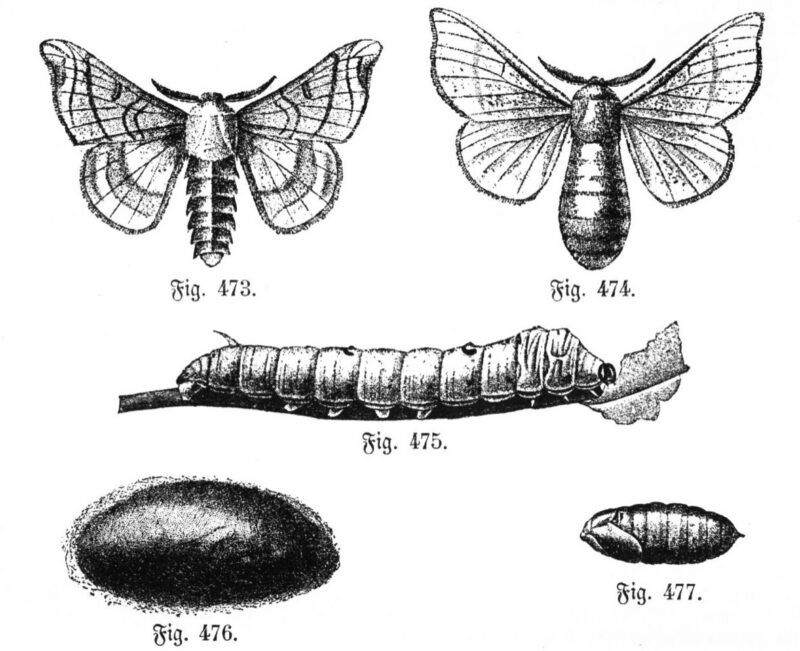
A Biological Tale
To grasp sericulture’s westward expansion, it helps to understand the biology of both the silkworm and the mulberry tree.
The silkworm, Bombyx mori—which produces the silk thread from its salivary glands—feasts exclusively on mulberry leaves for about thirty days, undergoing several molts, before threading its silk cocoon to metamorphose into a moth. It is sensitive to several environmental conditions, including temperature, humidity, light, and air. Ideally, it requires temperatures between 20 and 30 °C, with humidity carefully balanced: too little and the worms stop eating, too much and pathogens may develop.
For the white mulberry tree, Morus alba, the requirements are somewhat simpler: it thrives in both temperate and tropical environments—where there is ample light and rainfall, with well-draining soil.
Obtaining silkworm cocoons alone was therefore not enough to establish sericulture on new soil. In Asia, Mulberry trees were grown as bushes thanks to the favorable climate provided by the monsoon seasons. By contrast, the Middle East and some Mediterranean countries experience dry, hot summers with little rain. The mulberry trees there required deeper roots to capture sufficient moisture for growth. Therefore, it had to be grown into a tree rather than a bush, which took several years longer. And while the mulberry produces leaves as a bush, harvesting the leaves that early would kill it, leaving no other choice but to wait for it to mature into a full-grown tree. So, before any cocoons could be brought in for sericulture, it was best to first have a well-established mulberry tree cultivation with mature trees. And multiple trees were needed! About 200kg of mulberry leaves are required to feed 6,000 silkworms, which produce 1kg of silk.
Because both the silkworm and its food source required specific environmental conditions, transplanting sericulture beyond China was difficult. This biological dependency helps explain why silk traveled west as a luxury commodity long before the knowledge to produce it followed.
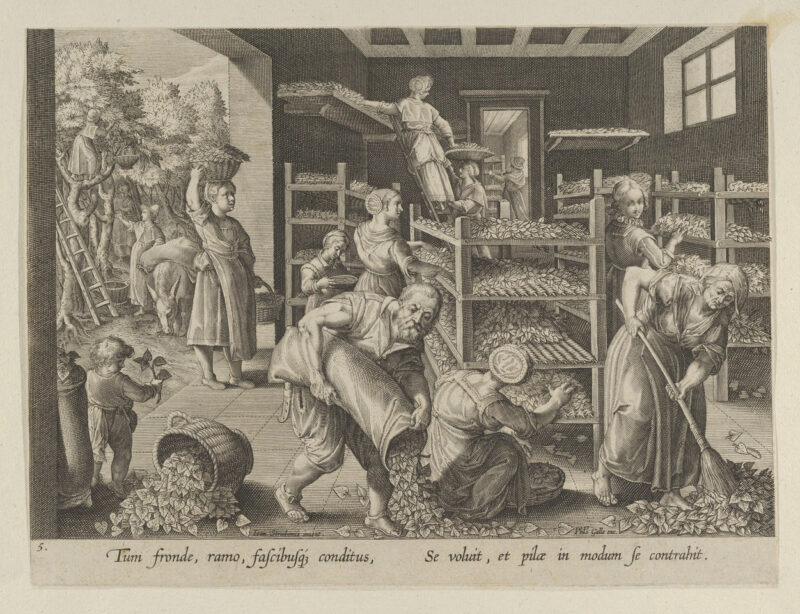
The Gathering of Mulberry Leaves and the Feeding of the Silkworms by Karel van Mallery (1595)
Silk : To Infinity and Beyond
Before it became a widely sought-after fabric, silk first developed within China. Once people learned to unwind the cocoon and extract its thread, silk rapidly became a prestigious commodity. The fabric was reserved for the emperor and royal families’ garments, as well as for their banners, flags, and other symbols of power. Cocoons, difficult to unravel, were repurposed as paper for imperial decrees and other royal documents.
Over time, silk spread widely throughout China and trickled into the trade routes to Korea, Japan, and Tibet. Slowly, these trade routes extended further west into the continent, to India and the Middle East.
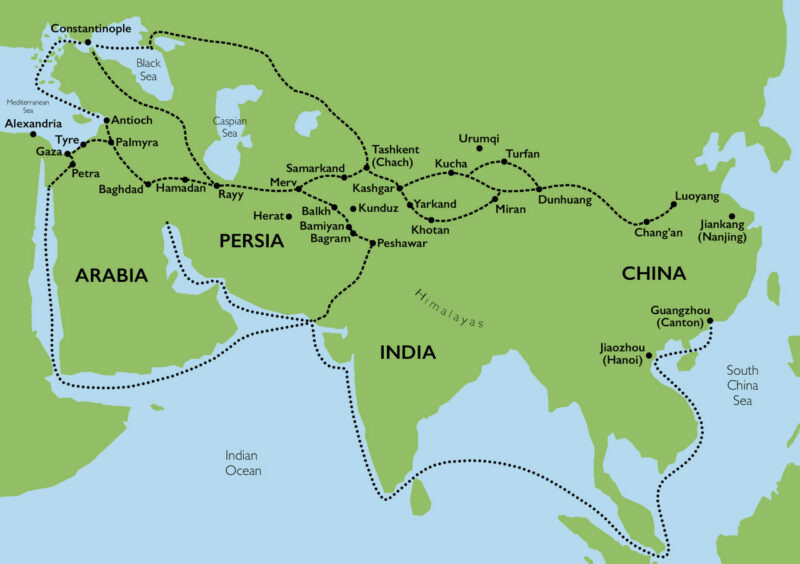
The Silk Road’s many trade routes, © Smart History
On the back of camels, silk fabric traveled up to 6,400km (4,000 miles) across the continent, crossing rivers, fortresses, deserts, stopping at times in oases cities, passing through valleys and mountains, salt lakes, capitals, and again through more mountains and more deserts. Caravans, often numbering hundreds or even a thousand camels, traversed some of the most inhospitable terrain in the world. These trade routes started in China and went across to the Middle East, and later, in the first century, silk entered the Roman Empire. Collectively, these routes are known as the « Silk Road. »
But the name ‘Silk Road’ is misleading, as it actually comprised numerous interconnected routes that evolved over centuries. Completing the entire journey was rare; caravans typically traveled shorter segments, linking one trade hub to another. Inns, known as caravanserais, appeared roughly every 30 to 40 km, providing rest and trade stops where silk and other goods could be bought, sold, or exchanged. Some of the goods exchanged on these roads included spices, crops, porcelain, dyes and minerals, precious stones like jade and amber, weapons, glassware, and even animals like horses, elephants, rhinoceros, and lions.
Beyond goods, these routes transmitted ideas, philosophies, religions, cultures, languages, and even diseases. In this way, silk helped weave a vast network of human cultures across continents.
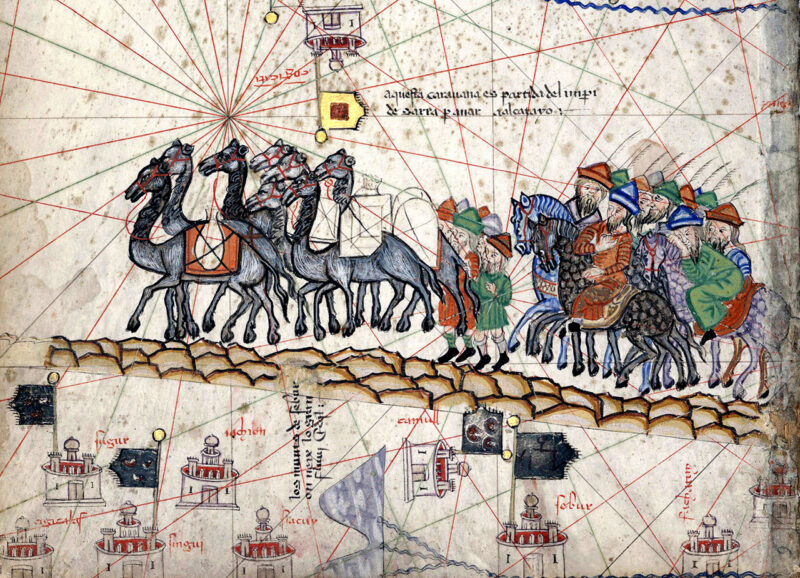
Caravans travelling the silk roads, C.E.1375
Sericulture Across the World
While the silk trade thrived, China safeguarded its silkworms for three thousand years. Imperial decrees imposed the death penalty on anyone caught attempting to smuggle silkworm eggs out of the country.
Meanwhile, the origins of silk were largely a mystery to the ancient world; the Romans, for instance, believed it was wool that grew on trees. But after millennia in its cocoon, the Lepidoptera eventually flew out to see the world, releasing all the secrets silk held in its threads.
Silkworms thus eventually spread across Asia. By the early centuries BCE, sericulture had spread to Korea, Japan, and parts of Central Asia.
As trade expanded across the continent, western regions grew increasingly eager to secure their own sources of silk. In 550 AD, it is said monks traveled to China and smuggled eggs back to the Byzantine Empire, though the truth may simply be that sericulture slowly trickled to the Byzantine Empire from Syria and India. Nevertheless, Constantinople, a flourishing trade city, became one of the main western hubs for silk. Emperor Justinian is credited with introducing sericulture to the Mediterranean.

Emperor Justinian Receiving the First Imported Silkworm Eggs from Nestorian Monks by Karel van Mallery (1595)
Europe would have to wait several centuries before sericulture reached its shores. In the 8th century, Iberia received silkworms via maritime trade routes from China, making Andalusia Europe’s primary silk-producing region. Silk weaving guilds also emerged in North Africa, notably in Tunis and Fez.
In the 12th century, mulberry trees were planted in Sicily. Thriving in the region’s ideal climate, the trees provided ample food for silkworms, enabling Italians to develop their own silk-weaving craftsmanship, meeting the high demand for silk among the nobility. Cities such as Venice, Genoa, Bologna, and Lucca became centers of skilled silk artisans, whose techniques would later spread across Europe.
During the same period, Pope Clement V, originally French, brought mulberry trees and Italian silk artisans to establish silk houses in Provence and the Comtat Venaissin (south of present-day Drôme). Although production was limited, this marked the beginning of sericulture in French history.
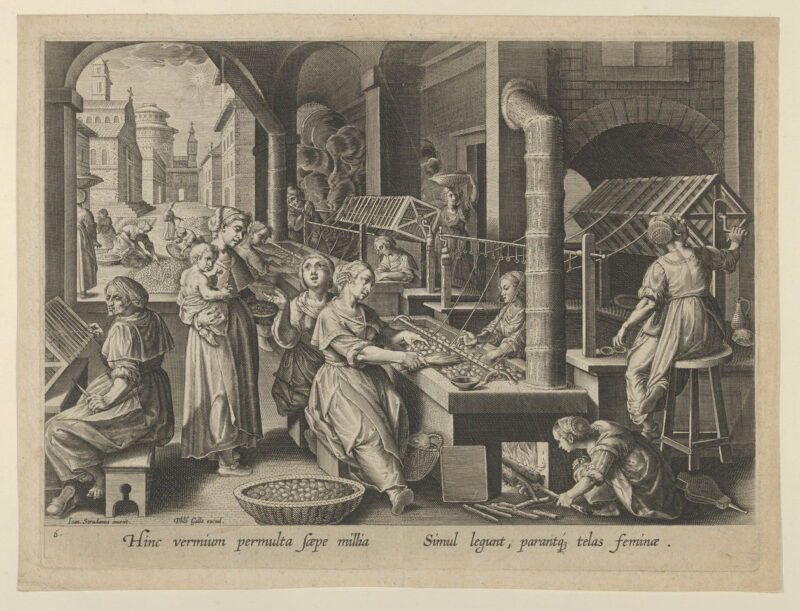
The Silkworm Eggs Spread Out On Shelves by Karel van Mallery (1595)
Sericulture of the French Kings
Although silk arrived in southern France in the 14th century, sericulture would only truly be established in the mid-16th century. Italian artisans from Florence, Venice, and Lombardy introduced silk production in Avignon, which eventually spread to Orange and Nîmes. The industry remained modest, as it was uncertain whether mulberry trees could thrive in the cooler climate. Any silk woven in France at the time still relied on imported fabric from Spain or Italy.
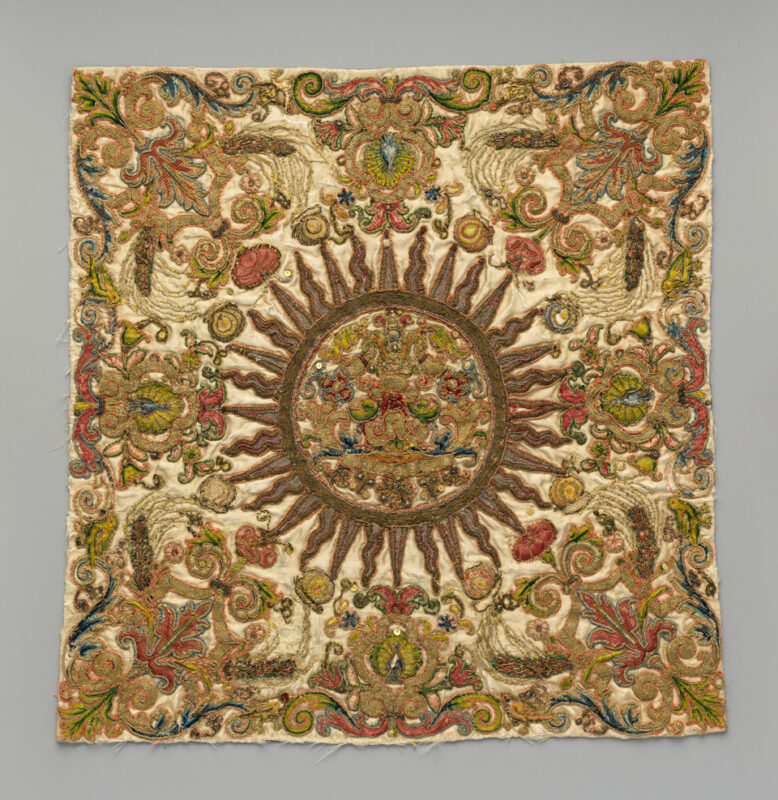
French chalice veil made with silk and metal threads (1500s)
The Valois Kings
King Louis XI sought to establish a domestic silk industry to curb the outflow of wealth caused by the elite purchasing foreign silk. He initially chose Lyon and issued a decree requiring citizens to fund weaving workshops. However, due to the city’s close ties to Italian merchants and banks, the initiative stalled and was eventually abandoned.
Italian artisans were instead sent to Tours, where Louis XI had planted mulberry trees and imported silkworms. By the mid-16th century, records indicate that around 11,000 looms were active in the Touraine region—though the fabric still remained largely imported from the south.
Lavish court commissions continued under Charles VIII, Louis XII, and Francis I. Weavers, embroiderers, button makers, and dyers prospered in Tours. In 1520, artisans were tasked with decorating the site of the diplomatic meeting between Francis I and Henry VIII of England, known as the Field of the Cloth of Gold. Golden tents, silk and velvet fabrics, intricate tapestries, and gilded sheets adorned the camp.
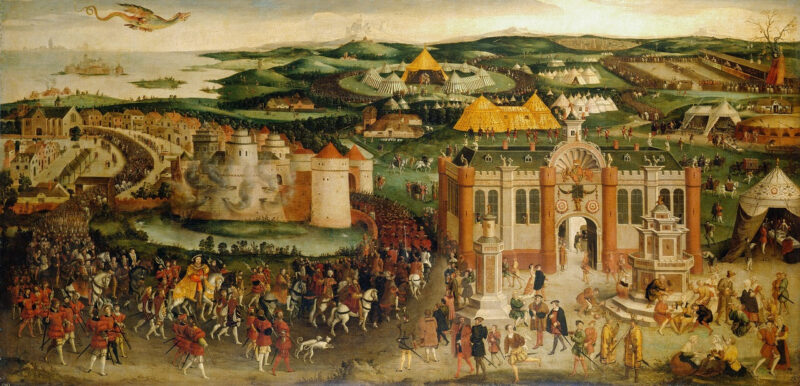
Camp du drap d’or, painted 1545, artist unknown
To reduce dependence on imported silk and weaken Genoa, with whom he was at war, Francis I re-established silk weaving in Lyon. Through patent letters granted to two weavers, Lyon was authorized to produce embroidered fabrics using gold, silver, and silk threads, attracting top artisans. The city’s economy flourished around silk, welcoming tissotiers, velvet weavers, gold drawers, mill turners, and velvet folders. Despite these advances, the finest silk garments still came from Italy.
The industry suffered during the Wars of Religion, as many skilled weavers were Huguenots who fled or were persecuted. Outbreaks of plague, such as the Black Death, further disrupted production and trade in key silk cities. Heavy taxation under Charles IX reduced domestic demand, weakening workshops across France. These combined challenges caused a temporary decline in silk craftsmanship until stability returned under Henri IV.

The origins of silk fabric manufacturing in Lyon by Pierre Bonirote (1536)
The Bourbon Kings
King Henri IV continued to develop the silk industry during his reign. To do so, he planted more white mulberry trees; in the Cévènnes and Ardèche areas, thousands of trees were planted in the Languedoc and Provence, magnaneries were established, and even in Paris, in the Tuileries Garden of Catherine de Medicis, mulberries took root. The French weaving industry would have its French-produced silk.
But French silk truly blossomed under Louis XIV. His minister, Jean-Baptiste Colbert, issued ordinances in 1667 regulating the silk industry in Lyon, imposing strict standards on production—such as fabric width, thread count, and material quality—while supporting the industry through tariffs and state patronage. At the same time, Louis XIV reinforced silk’s prestige through sumptuary laws that regulated the consumption of luxury goods, restricting silk to the crown and nobility—much as China and the Byzantine Empire had previously established.
Tours forgotten, Lyon emerged as the dominant center of French silk weaving. And much like the mulberry tree feeds the silkworm, Lyon dressed Paris in lavish garments, metamorphosing the city into the new European fashion capital.
French style dominated the European markets–in the south and the North, from Spain to Sweden, and even in South America. Only Italy, England, and North America managed to maintain their own style.
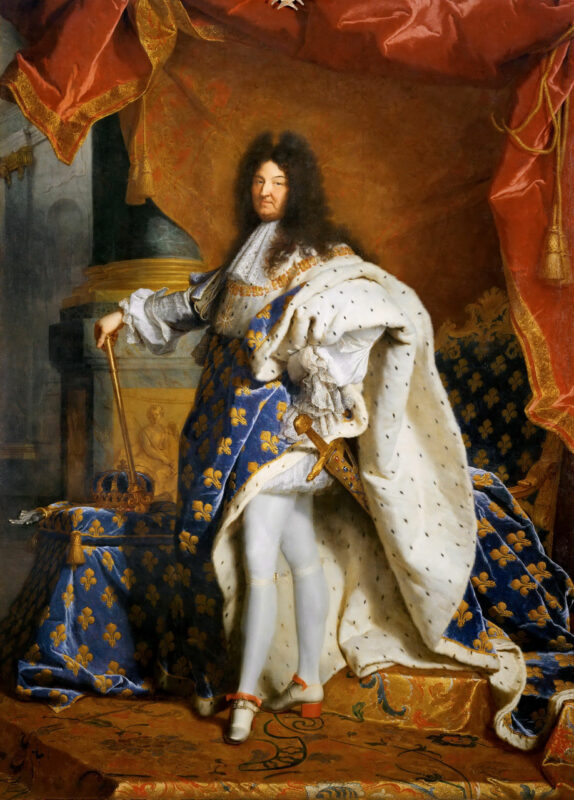
Portrait of Louis XIV in coronation robes by Hyacinthe Rigaud (1702). He is dressed and placed under a canopy made of silk.
Today, China remains the world’s primary producer of silk, followed by India, Uzbekistan, Turkey, and Japan. While sericulture persists in parts of France—mainly in the south—the majority of raw silk used by French manufacturers is imported. In Europe, Italy and France dominate the silk weaving industry, producing textiles for luxury clothing and high-end fashion houses.
From a Garden to International Fame
Did Empress Hsi Ling Shi realize what would come from that cup of tea when she poured it that day? From that cocoon emerged not a moth, but the beginning of a millennia-long journey connecting civilizations, cultures, languages, ideas, and people.
From the imperial courts of China, silk traveled across the vast routes of the Silk Road, eventually reaching the shores of Europe. Sericulture’s westward expansion proved slow yet fruitful. The initiatives of French kings helped establish a silk industry in France, allowing cities such as Lyon to weave delicate silk threads into fabrics that would dress courts and shape Europe’s luxury traditions—a luxury that still persists to this day.
All of that, from the spit of a tiny caterpillar.
 About the writer (photo right): Chloé Destremau, pictured at the Chateau de Chambord where the painting of the Camp du drap d’or can be viewed, is a freelance writer and the daughter of Christy Destremau, founder and owner of France Off the Beaten Path Tours.
Ready for your journey to discover the enchanting world of France?
- Check out remaining 2026 tour dates
- Plan ahead, check out our 2027 tour dates
- Contact us at christy@traveloffthebeatenpath.com to request space availability and/or ask questions.
- Message us on WhatsApp at +1.717.683.2827