

French Custom: La Bise (the Kiss)
by Chloe Destremau
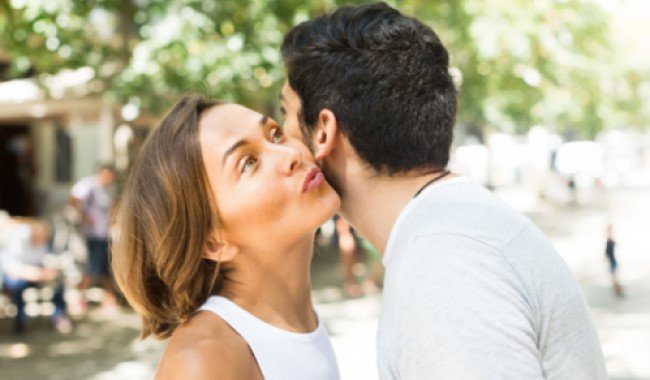
La bise (pronounced « lah beez »), or kissing one another on the cheek, is one of the most common social customs in France. Every day, French people greet their friends, family, colleagues, and acquaintances with this small ritual.
I grew up in Finistère (western France), where we kiss only once, on the right cheek. When I later moved two hours away to the Morbihan—still in the same region, Brittany—I was surprised to discover that people exchanged two kisses, one for each cheek. I later learned my version of la bise, the single cheek-kiss, was an exception rather than the rule.
So why does this tradition differ so much even within such a small geographical area? Where did it even come from, anyway?
The Ancient Bise : Not So French After All
We tend to think la bise is purely French, but it is actually practiced around the world. Variations of la bise can be found from Latin America, like Brazil and Argentina, to sub-Saharan Africa, the Middle East, and even parts of Russia. Interestingly, many Northern and Eastern European countries, such as Norway and Slovenia, do not share the custom, and in North America it is largely limited to Québec.
Of course, the custom is more or less different in each country. In Belgium, a single cheek-kiss is customary, while in Switzerland three are more common. Social norms also play a role: traditionally, la bise is more frequent between women or between men and women. In France, however, exchanging la bise between men is becoming increasingly common, which reflects a shift away from older social stigmas.
Some historians trace the origins of social kissing back to the Romans. During antiquity, kissing was integrated as a social language. There was the osculum, a closed-lip kiss exchanged between people of equal rank. It could be given on the mouth, cheek, or hand. There was the basium, which was more of a tender kiss reserved for family members or lovers. And finally, there was the suavium, a passionate and erotic kiss—an ancestor, perhaps, of what we now call the “French kiss.”
How Many Bises?
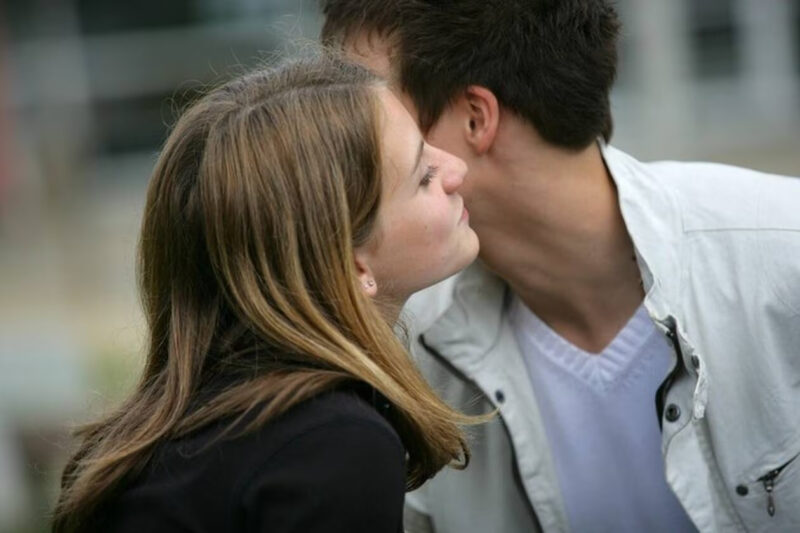
Interestingly, la bise is not exactly a kiss. The English word « kiss » is slightly misleading, because in practice, people rarely press their lips to the other person’s cheek. Instead, the cheeks lightly touch while a small kissing sound is made in the air.
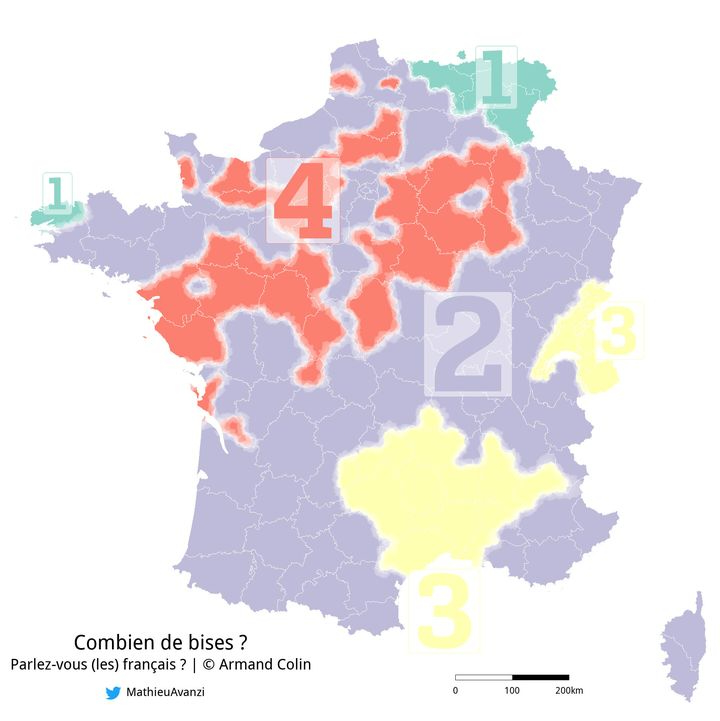
Today, the custom varies across France. In most regions, the tradition is two cheek kisses. But in parts of southern and eastern France, three kisses are more common. Some historians suggest that this triple kiss may be linked to 17th-century Protestant traditions, in which the number three symbolized the Holy Trinity: the Father, the Son, and the Holy Spirit.
In several departments in the center of France—including Aube, Yonne, Haute-Marne—areas around Paris, and the Vendée in western France—people greet each other with four cheek kisses. A study estimated that older generations did the four cheek-kiss more often than younger generations, which leaned towards the more common two cheek-kiss. Only time will tell if the four cheek-kiss will persist through time or if the practice will cease entirely.
And in one small corner of Brittany, in the northern part of the department of Finistère, the custom is just a single kiss. This tiny area is the only place in France where la bise is only once, and of course, it’s where I grew up. Kissing twice has become second nature, but the single-kiss cheek still remains very natural for me to do if I am greeting someone from Brest or Morlaix.
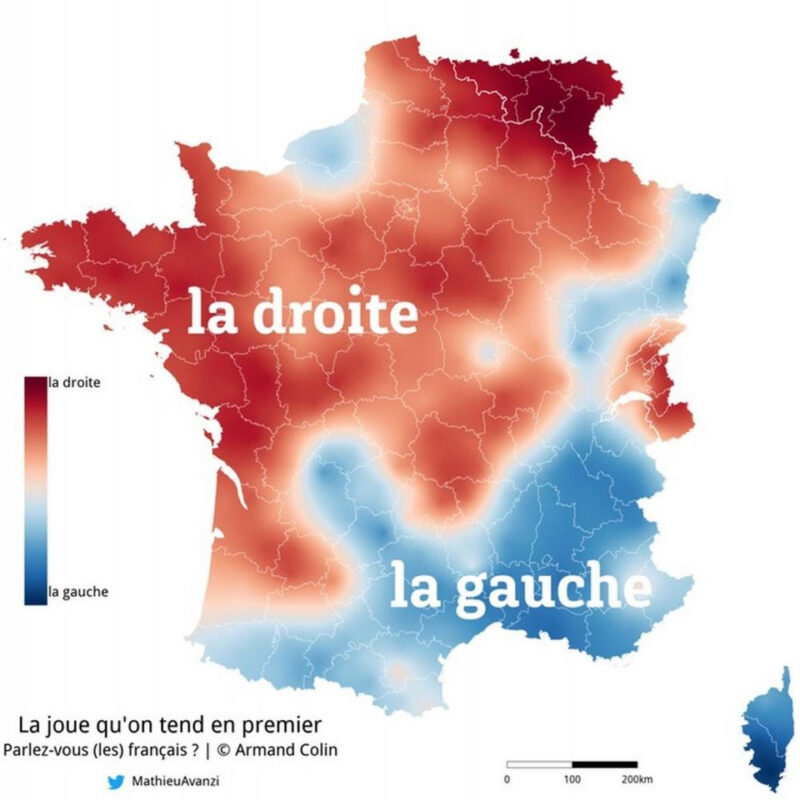
Even once you know the correct number of kisses, another question remains: which cheek do you start with?
In most of France, people begin with the right cheek. It’s how I personally have always gone about my greetings. Though sometimes, it happens that both people lean the same way and end in a comical shuffle. Oops!
Indeed, in parts of the southwest, the southeast, and in Haute-Normandie, the bise usually starts on the left. But there is no way of knowing which side the other person will choose when you’re greeting for the first time, so at that point it’s less about etiquette and more up to fate. Worry not, according to a recent study, about 15% of French people are unsure which cheek to choose as well!
And just like the number of bises themselves, the reason for this variation remains a mystery. Historians are perplexed by the evolution of this ritual since there is no clear point or reason as to why the custom varies so much within regions.
To Bise or Not to Bise?
The bise has persisted over time despite several societal events hindering the practice. In the 14th century, Europe was struck by a devastating pandemic known as the Black Death. Physical forms of greeting were thus discouraged—and in some cases, seen as suspect—and the practice vanished, before being brought back in the following centuries.
Similarly, the COVID-19 pandemic in 2020 put a dent in the custom. Kissing each other as a greeting came to a halt. Other ways of greeting were adopted instead: a head nod, a touch of the elbows, or of the feet.
The practice returned in the following years, but the pandemic begged the question: should we continue?
It turns out, stopping the practice came as a relief for some. Physical contact does not suit everybody. Some may dislike the contact, some may simply be mindful of their health. As you can imagine, the physical contact of la bise is a fabulous vector of diseases. The propagation of colds, the flu, COVID, and many other infectious diseases would certainly decrease if we stopped kissing each other.
Yet refusing the bise when the greeting has begun can be quite tricky. It can come off as standoff-ish, perhaps even a little rude. The easiest way to get out of it is to simply pretend to be sick. But why is it taboo to simply refuse the practice, for any reason at all? Well, faire la bise is a social code, a way to say we belong to the group.
A way to remedy social tension is to simply vocally acknowledge not participating in the practice, « I don’t do la bise », which maintains the social recognition and puts the other at ease. As if saying, I don’t partake in this custom, but I still belong to the community.
When I moved back from the States after living there for 6 years, la bise had completely left my social language. And unless the other person initiates the greeting, I don’t instinctively think of doing it either.
Though I don’t necessarily want la bise to disappear completely, I find I value the custom with close friends and family more than with loose acquaintances.
At the end of the day, most only greet their close ones this way or in environments where the custom has already been established, but ultimately it comes down to personal preference. To bise or not to bise, how many times, and starting from which cheek, is up to each of us.
Perhaps I’ll go back to my roots and kiss only once, or maybe I’ll start greeting from the left cheek just for the fun of it.
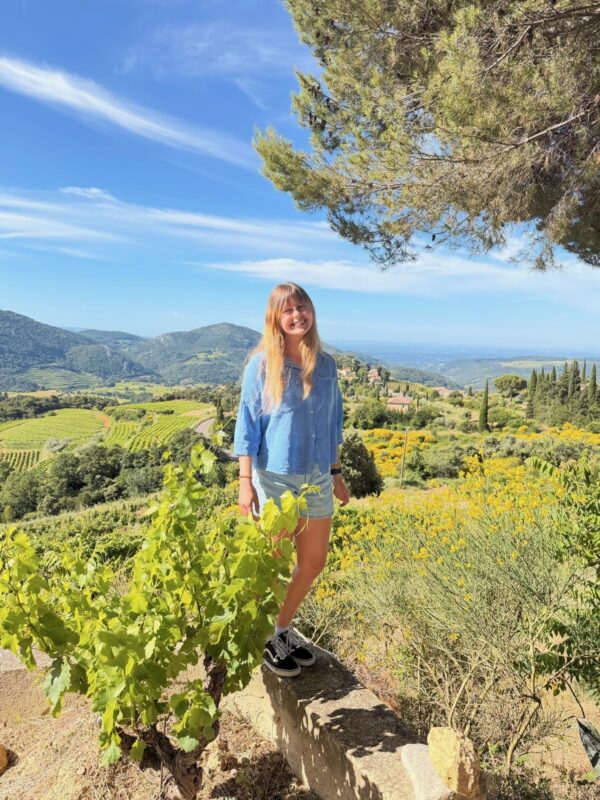 About the writer (photo): Chloé Destremau, pictured here at our winery in Provence, is a freelance writer and the daughter of Christy Destremau, founder and owner of France Off the Beaten Path Tours. Chloé joined the France Off the Beaten Path Guiding Team in 2025.
Ready for your journey to discover the enchanting world of France?
- Only a few spaces remain available on 2026 tours – Check out the Schedule here
- Plan ahead – 2027 dates filling fast – check out ALL of our 2027 tour dates
- Contact us at christy@traveloffthebeatenpath.com to request space availability and/or ask questions.
- Message us on WhatsApp at +1.717.683.2827