

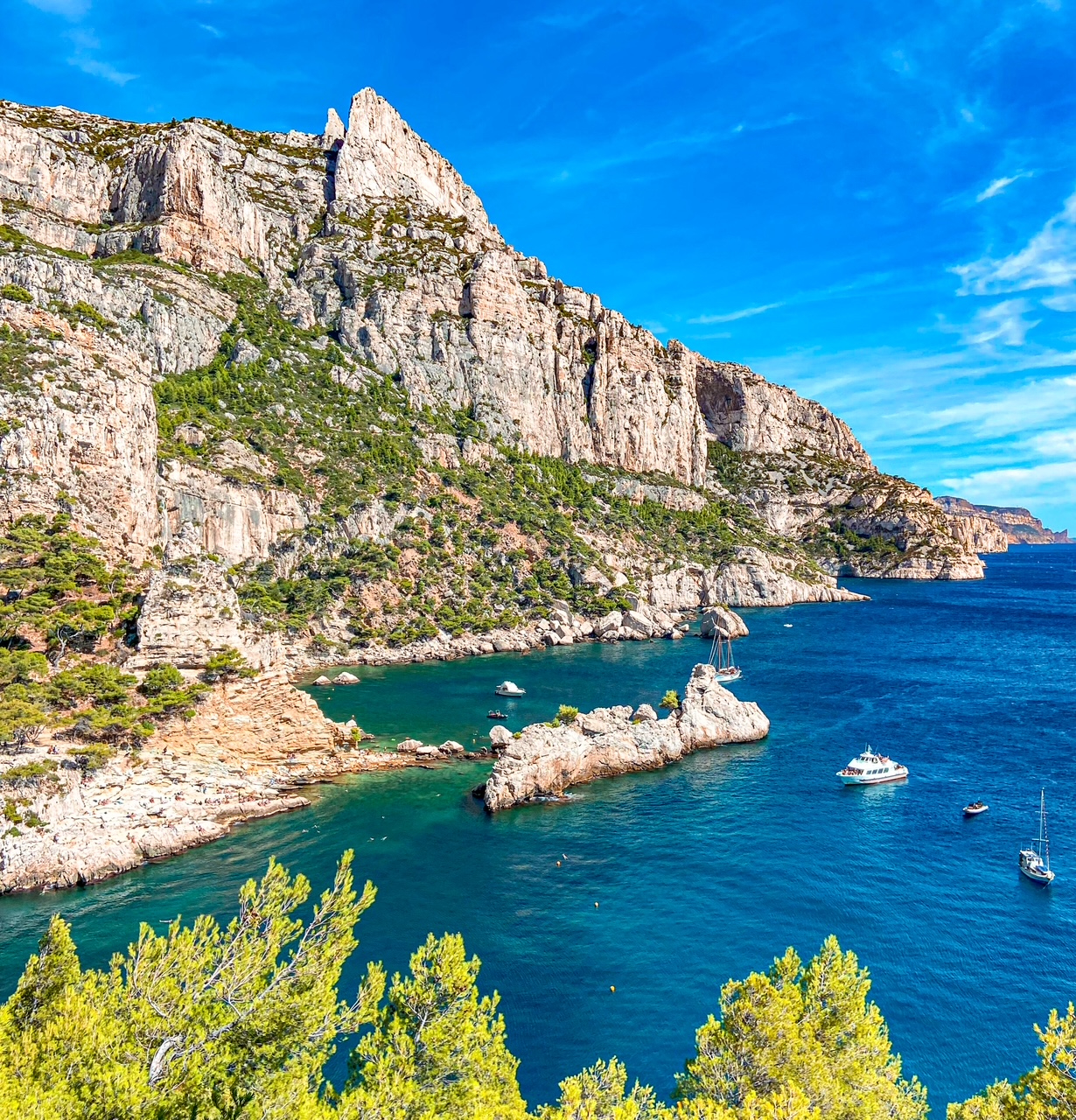
Calanques of Sugiton, Where Adventures Begin
by Chloe Destremau
My University campus for grad school sat far from the center of Marseille, on the fringe of the Calanques National Park. It was surrounded by tall, looming mountains. One of those peaks belonged to the Calanque of Sugiton, one of the most visited calanques of the Park. This natural site offers incredible hiking trails, endemic flora and fauna species, and unforgettable experiences.
My first time hiking this calanque was one such unforgettable experience. It marked the beginning of a new chapter in my life — I had just moved back from the States after 6 years away. France had become a distant land of a different time, so while I had grown up French, everything seemed a little foreign. But tackling Sugiton in the second week of classes with a group of classmates cemented the start of something new—a new path in life and a rekindling of my ties to my home country.
For me, the adventure began before I had even set foot on the trail. I drove my car to campus instead of taking the bus. I had to overcome the first challenge of the day : parking. Only registered vehicles can park on campus on weekends, and the trailhead lot fills up quickly. Fortunately, though, in Marseille, any surface area is a free parking space. After a few loops around the lot hunting for a curb, a sidewalk, or an inch of free road, I managed to squeeze my Peugeot between two cars.
The parking lot wasn’t just teeming with people; there were wild boars resting in the shade, and some were rooting through the trash. Habituated to humans, they’re not an uncommon sight at the Luminy campus. Some people feed them — outside of the odd tourist, a group of locals drives in late at night to drop off leftovers. But, like all wildlife, feeding them is prohibited—so please don’t be tempted. It causes more trouble for both them and us.
Usually, the locals barely spare them a glance, so I did the same, walking right past a sounder of four to join my friends at the forest entrance.
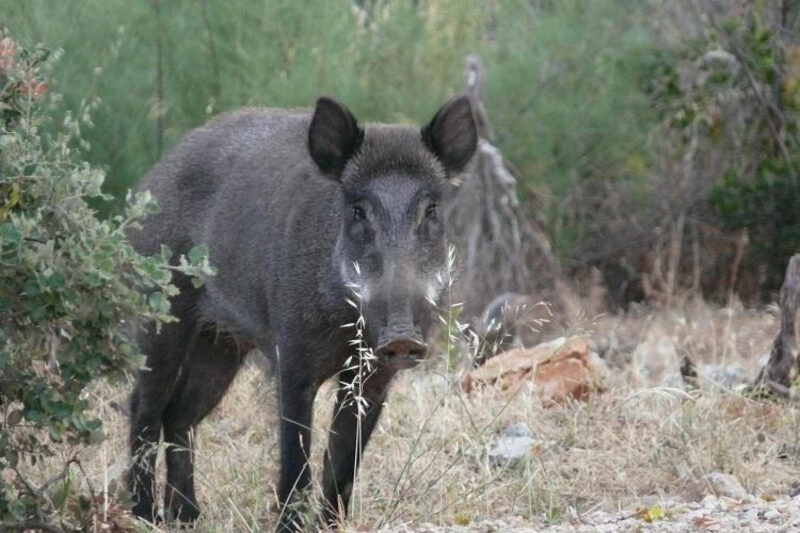
Wild boar at Luminy campus, © Marseille Tourisme
We briefly discussed the day ahead. The main trail of the calanque, and the one I recommend, begins in the Luminy forest (about thirty minutes in) and goes straight down to the calanque. It’s the most direct route. But my friend, Manon, suggested a different path: a loop on the mountains that goes around Sugiton’s cove. It would start along the crest overlooking the neighboring calanque, Morgiou, then descend to Sugiton’s inlet, and finally climb back up through its pass. On the hiking app, the elevation graph looked like an insane rollercoaster.
« It’s only four hours », my friend Manon had promised.
It was not only four hours.
But we were ready to overcome this challenge, our packs heavy with lunch and snacks. Halfway through the forest, we left the main trail and climbed onto a narrow, rocky ridge that carried us to Morgiou. The calanque slowly unveiled itself to us, proudly showing us its small port filled with barques and boats. The water, dark with Posidonia, glistened in the sun.
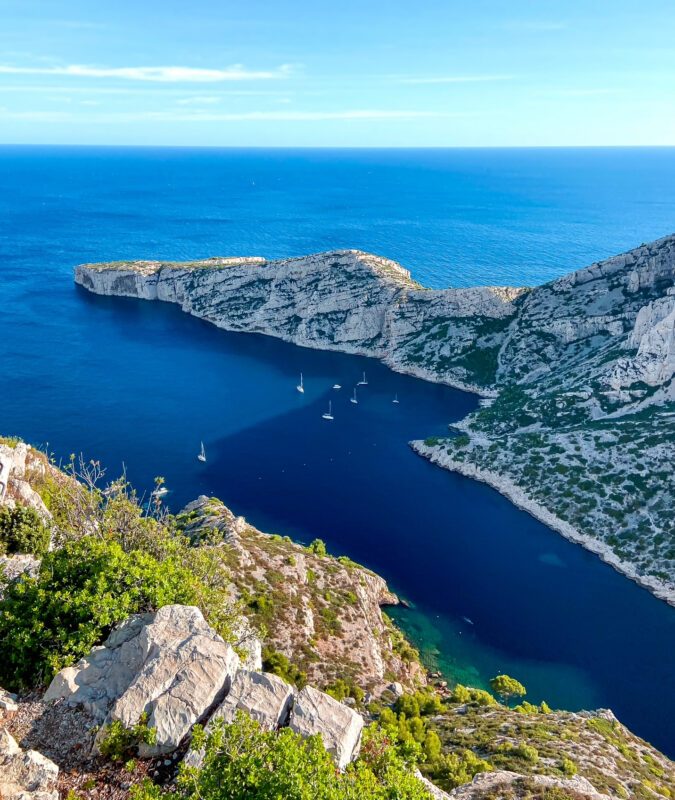
Entrance to calanques de Morgiou. © Chloe Destremau
Morgiou is a long calanque with surprisingly few beachy access points to the sea, largely because the fishing port occupies most of the inlet. Being exposed to strong winds and lacking a natural spring, Morgiou, back in the day, was inhabited only by fishermen drawn to its deep, productive waters. The little village ended up being built around the trade.
And much like we were hiking down the mountain, 400 years ago, a king of France traveled the same path. In 1622, Louis XIII attended a demonstration of madrague fishing in the calanque—a technique in which the fish are gathered in a net trap before being harvested. Louis XIII, with a silver-plated trident, harpooned the tuna himself! The whole city had followed him through the mountains and cheered him on from the rocky shore. For the king’s disembarkation from the boat, the locals even carved steps into the stone, « Louis XIII’s stairs. » They’re still visible today, but have quite weathered over time, so caution is advised.
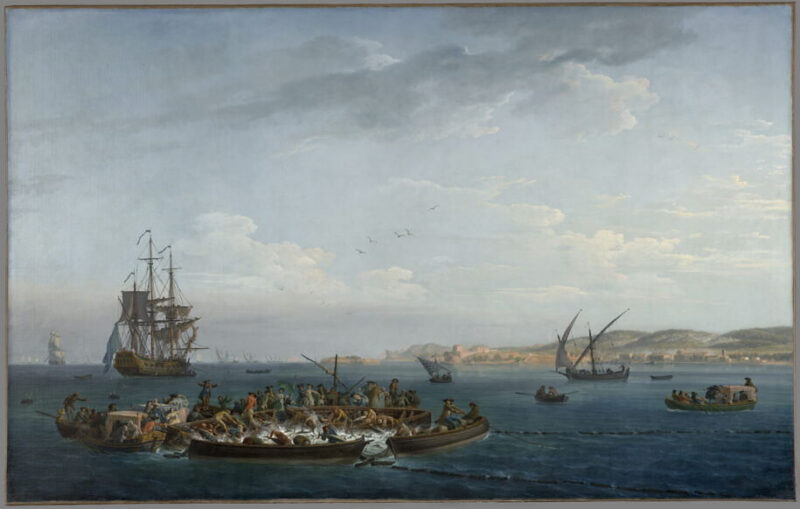
Madrague fishing © Louvre
Once we let Morgiou behind us, the trail disappeared into a wall of rocks. No one had bothered to carve steps for us. Instead, in a crook, on the adjacent wall, a chain was embedded into the limestone. All of us were quite apprehensive, except for Javiera, who climbed straight down by-passing the chain entirely. The rest of us chose the safer route. I grabbed the chain, stepped into the air, and tiptoed onto the rock. It felt like I was climbing down a hundred-foot cliff. Once on the ground again, I watched Manon and Léa each take their turn and realized the giant cliff I had just been climbing down had simply been a medium-sized boulder. I couldn’t help but laugh. “Don’t laugh!” Léa had objected as she was navigating the five-meter-tall rock. It had only made me laugh harder.
Once we were all back on solid ground, we brushed off our pants and prepared for the next leg of our wild adventure.
At the edge of the ridge, overlooking a small cove carved into the rock, we finally stopped for lunch. The Mediterranean Sea stretched before us, taunting with a sea breeze that only the boats offshore could catch in their sails. I drank from my 250ml water bottle, already warm and near empty. I questioned my morning self for selecting such a small bottle. We were only halfway through the hike. But I guess I could not be worse off than Léa, who was from Orléans and not used to the southern sun, who’d brought a frozen bottle of water. It had barely melted at all. « It seemed like a good idea at the time, » she said, catching only a drop or two of water.
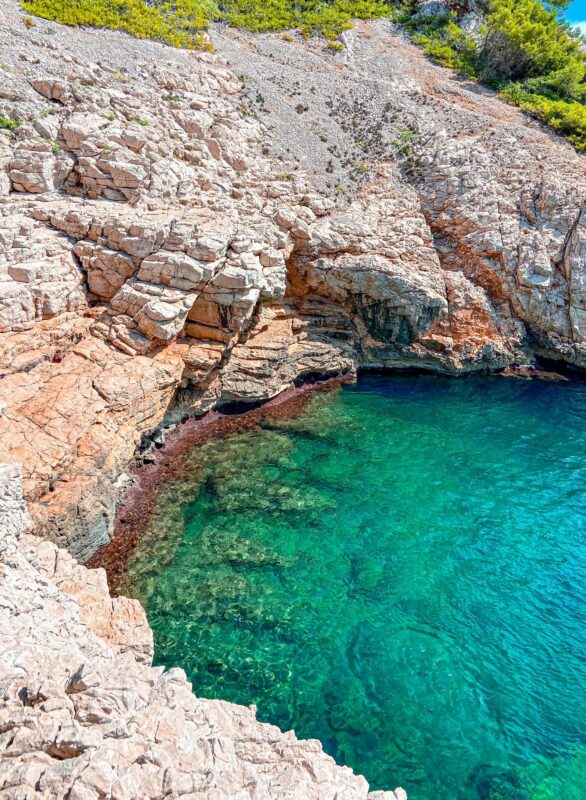
One of the semi-submerged caves of Sugiton © Chloe Destremau
Below our feet, down at the bottom of the next cliff, is a semi-submerged cave. Called the Blue Cave for its blue illuminations, it’s got a fifty-centimeter opening accessible to snorkelers and swimmers. The cave itself is easiest to reach by boat or kayak, but some make the trek and then swim to check it out.
With the allure of the Blue Cave below, we weighed our options. But time was short—Manon had heard the swim could be long—so we chose instead to devour our sandwiches before moving on.
To avoid a long loop, we went off the beaten path and climbed an area of loose gravel. We crossed paths with a couple mid-way up. The man, shirtless, tanned as can be, was carrying his child in a basket, while his wife was behind in a towel. Both were wearing flip-flops. They greeted us in a thick southern accent, before swaggering away for their casual promenade. We continued on to the top, nearly on all fours, sweating all the water we’d just drunk. Using a lone pine tree, we pulled ourselves back onto the trail. The sun was nearly at its zenith. Maybe not the most brilliant idea we’d had, but we were on an adventure.
Sugiton, from sègi « war base » in Provençal, doesn’t bear the expected inlet of a typical calanque, and instead has two little coves. We could see them from the elevated terrain before our rocky path dropped suddenly. The trail took the shape of a rusted ladder. No steps for us yet again. But the ladder turned out to be sturdier than it looked, and it safely brought us down to land. Just beyond, the turquoise water of the Mediterranean danced in the sunlight, waiting for us to join her.
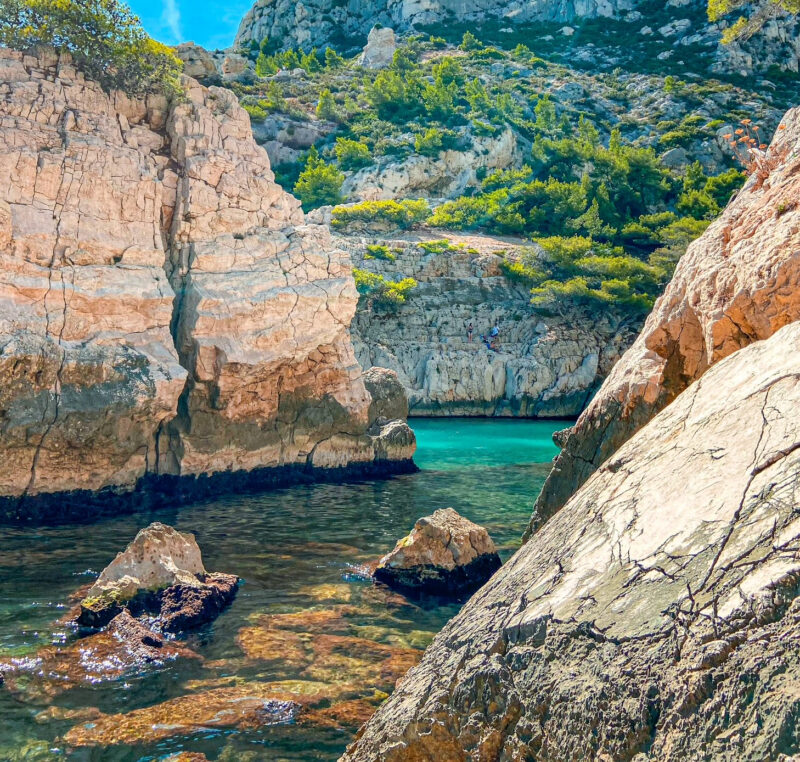
The coves of Sugiton. © Chloe Destremau
And we did. Grabbing our masks and snorkels, avoiding the long-spined sea urchins nestled in the crooks of the rocks, we sank into the water. The world turned into a splash of colors; schooling salema reflected yellow sparkles from their scales, accompanied by sea breams—white and two-banded—contrasting with the orange and red stripes of rainbow wrasses huddled along the walls. The sun, glimmering onto the sandy bottom, offered a play of contrasting wavy rays. The Cystoseira algae, hugging the rocks before standing back up into another embrace—revealing gastropods and mollusks as they weaved one way and another—reflected greenish speckled hues against the turquoise water column.
A colorful ecosystem for such a productive one; Cystoseira sequesters lots of carbon dioxide and sustains diversified trophic levels (herbivores, carnivores). Found at shallow depths, it provides shelter, habitat, and nurseries for many species while also reducing wave disturbance, sediment resuspension, and coastal erosion. It’s got quite the résumé. And because I cannot help myself as an ecologist, I must mention the threats it faces: coastal development (a common threat for marine life), anchoring, and overgrazing by sea urchins due to the overfishing of predatory fish. Cystoseira is also what we call a bioindicator of coastal health—in other words, it acts as a canary in a coal mine. Changes in Cystoseirareflect the overall health of the coastal ecosystem. It’s an important species in the Mediterranean, and though it is not as flashy as the seagrass Posidonia, it is just as important.
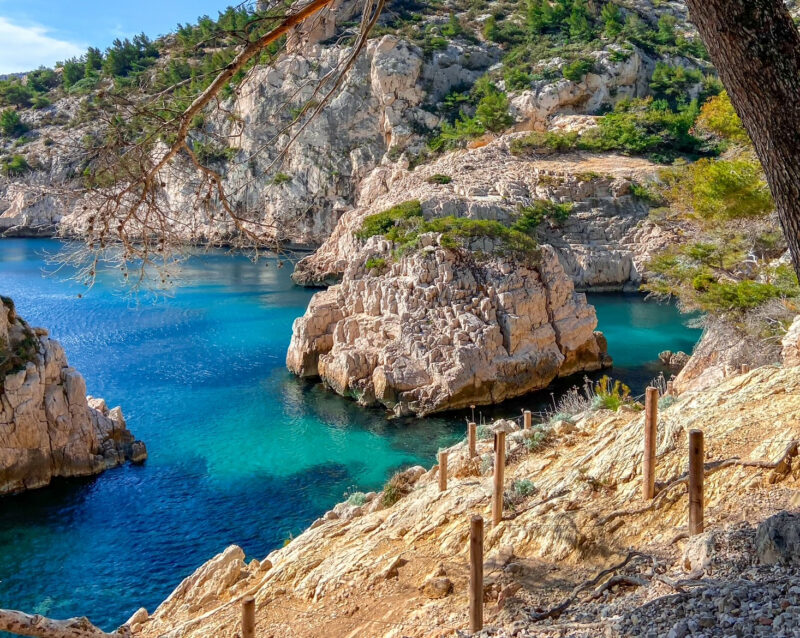
The two coves of Sugiton from the trail. © Chloe Destremau
We could’ve swum around the coves all day, but we had a hike to get back to. Leaving the sea behind, we gained in elevation once more. It was the final part of the hike, the last challenge. There were no trees or shade of any kind, just garrigue, maquis, and rosemary bushes, and the smell of thyme and lavender.
Then we hit Sugiton’s pass. The passage was high up at the top of more rocks between two cliffs. There was no other way but to climb. This time, there was no chain, no rope, no ladder, no easier trail (and still no steps). We had a final wash of water from what we had left, and, rolling up our sleeves, we tackled the pass. The narrow passage grew sharply steeper. We were soon on all fours, one behind the other. I was first in line.
« Don’t trip, yeah? » Léa called out, who was the last one in line, « This is not how I’ll go. »
I turned around to look at her and instead caught sight of the sea on the horizon, so small and distant yet incredibly vast.
We finally negotiated our way through the pass. The calanque rested before us, its crests rolling down into the sea. The little island, Sugiton’s Torpilleur, kept watch at the calanque’s entrance. Up here, we caught the sea breeze and cooled the sweat on our brows. We stood in silence, and watching the Mediterranean we had come to study. It held, in its ultramarine depths, all our fears and aspirations. There wasn’t as much apprehension as there was excitement for what was to come ahead. Our packs were light, our food eaten, our water drunk or evaporated—except for Léa’s bottle, astonishingly still frozen—but we did not mind. This was it. Two years of vigorous classes with an internship to conclude the final six months. Who knows what could happen in that time, all the possibilities that might emerge from the sea.
The view of Luminy’s pine trees marked our final stretch. We were parched. Fortunately, the parking lot is equipped with a tap at the forest entrance. We each took turns gorging ourselves with water as if we’d survived days of dehydration, lost in the wilderness.
The hike ended up being six hours. I went home with a sunburn, heavy eyelids, and an unforgettable experience.
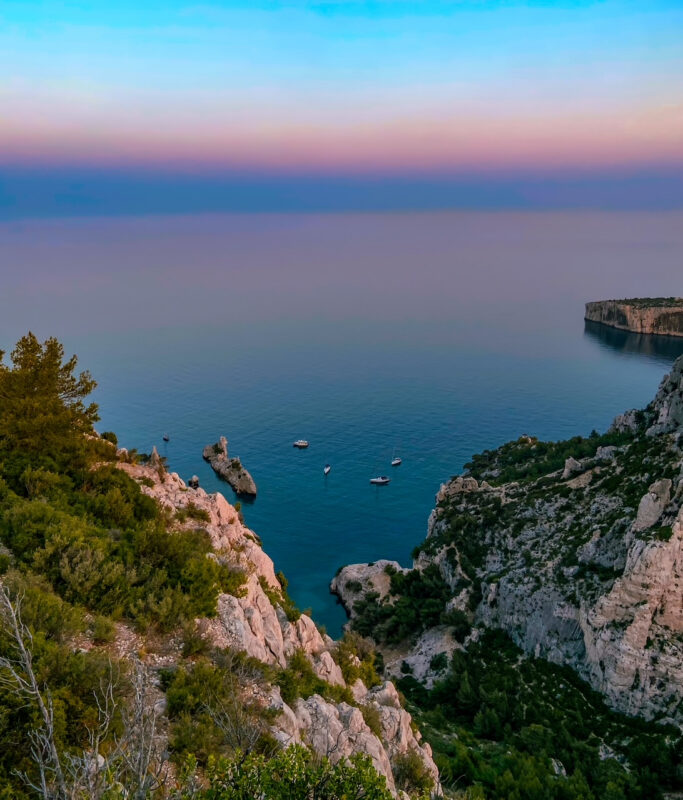
Sugiton and its Torpilleur at sunset. © Chloe Destremau
That hike has stayed with me, not just because of how unprepared we were or how long it took, but because it marked a new chapter in my life — it reaffirmed the choice I had made to move back to France. Léa and Manon remain some of my closest friends still today, and much like the crests and valleys of Sugiton, their friendship carried me through the ups and downs of my Master’s.
I’ve gone back to Sugiton many times since, but I haven’t done that hike again — taking the main trail down to the coves is just as nice and much quicker.
Recommendations
Sugiton has an impressive belvédère. I highly suggest heading up to it before going down to the coves. From up there, we truly get a sense of Sugiton’s vastness; the mountains loom above us, falling down into the sea, pointing to its crystalline water. It’s breathtaking.
Since there are no fresh water points, no trash bins, and no toilets in the Calanques de Sugiton, I’d make sure to take enough water and a plastic bag for trash. I’d descend early in the morning while it’s still relatively cool, though sunsets are quite gorgeous as well.
Because of its incredible views, it’s a popular calanque during the summer. To limit erosion due to foot traffic, Sugiton requires a free online reservation before visiting. The reservation is valid for the entire 24-hour period, and you’ll need to carry a copy of the reservation and a piece of ID.
Outside of the high season, it is still as sunny as summer, but perhaps a little cooler. May and September are ideal—though I have hiked the calanques in shorts and a T-shirt in February.
And for the more free-spirited, a nudist beach lies just beyond Sugiton, in the Calanque des Pierres Tombées. Enjoy!
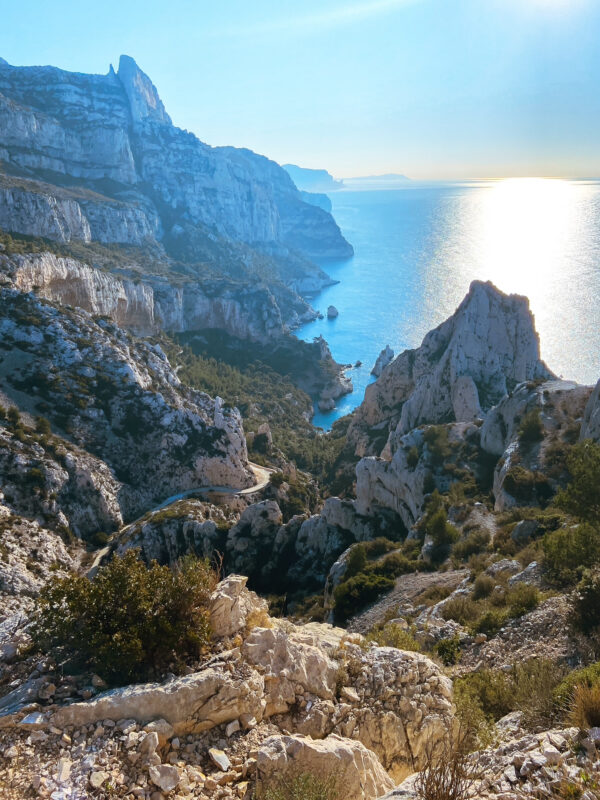
The view from the belvédère. © Chloe Destremau
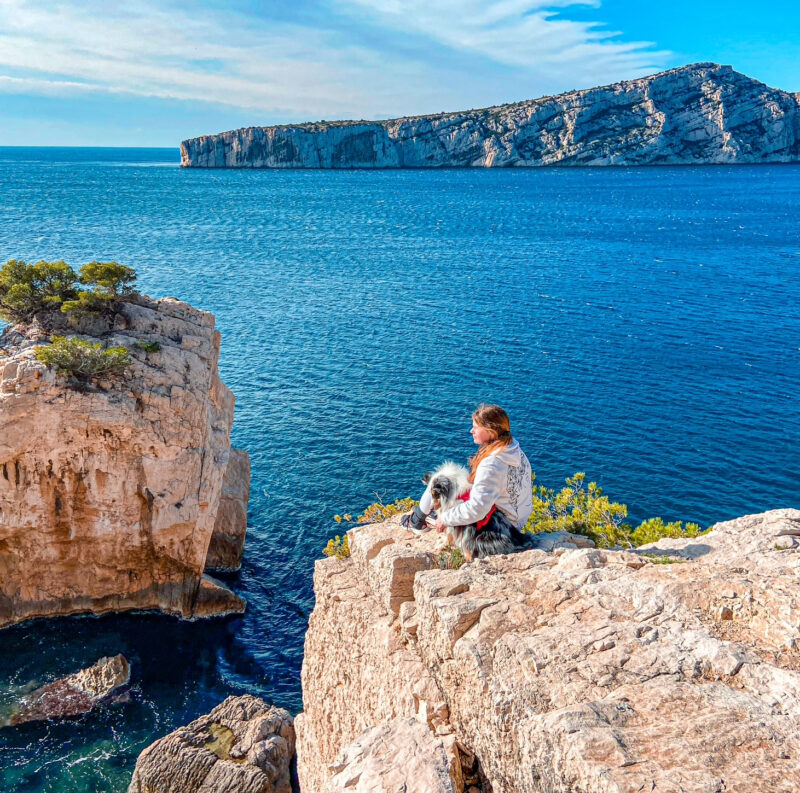 About the writer (photo): Chloé Destremau, pictured with her fur baby Nova hiking the calanque de Sugiton, is a freelance writer and the daughter of Christy Destremau, founder and owner of France Off the Beaten Path Tours. Chloé joined the France Off the Beaten Path Guiding Team in 2025.
Ready for your journey to discover the enchanting world of France?
- Check out remaining 2026 tour dates
- Plan ahead, check out ALL of our 2027 tour dates
- Contact us at christy@traveloffthebeatenpath.com to request space availability and/or ask questions.
- Message us on WhatsApp at +1.717.683.2827