


Calanque de Sormiou « The Best Spring »
by Chloe Destremau
The Calanque de Sormiou
There is, at the very edge of Marseille, a rocky shore of cliffs that cut into the Earth, each with a streak of water burrowed into the limestone. As if the ocean wanted to touch land with the tip of its fingers. These inlets, scattered eastward of the city, bear their own shapes of rock, their own outlines of crests patterned of peaks and dips, and their own inlet, some small and homely, others big and transcendent.
Not so long ago, I resided five minutes from one of these river-made fjords, the calanque de Sormiou. It’s one of the biggest of the Calanques National Park. Though when I say I lived minutes away, I am misleading. I was minutes from the trailhead, which was dug out at an early stage in the cliffs’ formation, where the pine still found roots in the limestone. But an hour of hiking still awaited me. There is a road to go down to the inlet, sure, but there is something almost dishonest or wrong about taking a car to reach such a beautiful place. Maybe it’s the clash between a man-made machine against such a pristine backdrop, or maybe it’s because the calanque ought to be experienced rather than visited.

Sormiou, protected by its cliffs. © Chloe Destremau
Its Beauty
The beauty of the calanque is difficult to describe. My first reaction upon seeing Sormiou was something like: «Oh my god, « you’re kidding me», « no way this is real, » reaching forward to ensure I wasn’t staring at a poster. I was not. My words were spoken to no one in particular—just a noise that would drift into the wind and over the ridge, heard by no one besides my dog (and a flying gull or two). Nova had side-eyed me, perhaps wondering how I could not trust nature to create such wonders. I had added a couple of non-flowery words I won’t repeat here, to which Nova, this time, looked away, embarrassed.
Fair.
We trekked down to the inlet on our first hike, for the pebbled-sandy beach, to feel the Mediterranean Sea. The water is colder here because of the underground freshwater spring that flows into the inlet. It’s actually why it’s called Sormiou, which means « best spring » in the Provençal language. This used to be an important water source back in the day for both fishermen and excursionists.
The Beginning
There was, in the late 19th century, a hiker’s club in Marseille called Les Excursionnistes Marseillais, and they were among the first to assign a signage system to mark hiking trails. They cared deeply for these calanques; they explored, mapped, and strolled through the hills, much like I was doing. They had seen what I was seeing—they would have understood, I believe, the need for me to stop nearly at each step and watch my surroundings. I do mean watch—and not look—what lay before me; the valley stretching below, its peppered greens waving one way and another. Listening to the rustle of its thicket and the whistle of the wind, whispering through the leaves and flowers, echoing up against the pores of the rocky walls. Nova and I were alone, and each time we started again, we added the crunch of gravel beneath our feet to the ambient noise, like we were part of the song. We lost sight of the ocean as we moved downwards, slowly being swallowed by the cliffs. It sounds paradoxical because we were moving toward the sea, yet each turn revealed more boulders, more jagged walls taller than the ones before, with new crests that went this way and that way. I wondered if I was lost. Could I have been part of the Excursionnistes Marseillais club?
And then, at a final turn, the trail funnelled out, the rocky ridge sloped down in reverence, and the sea opened to us. The inlet shone with its turquoise waters, inviting us to swim. The rugged shoreline protected us from the outside world as it continued on each side of the inlet.
Stepping onto that beach was disconcerting, almost because this piece of paradise belonged here. And better yet, it was a five-minute drive and an hour-long hike from where I lived. How lucky was I?
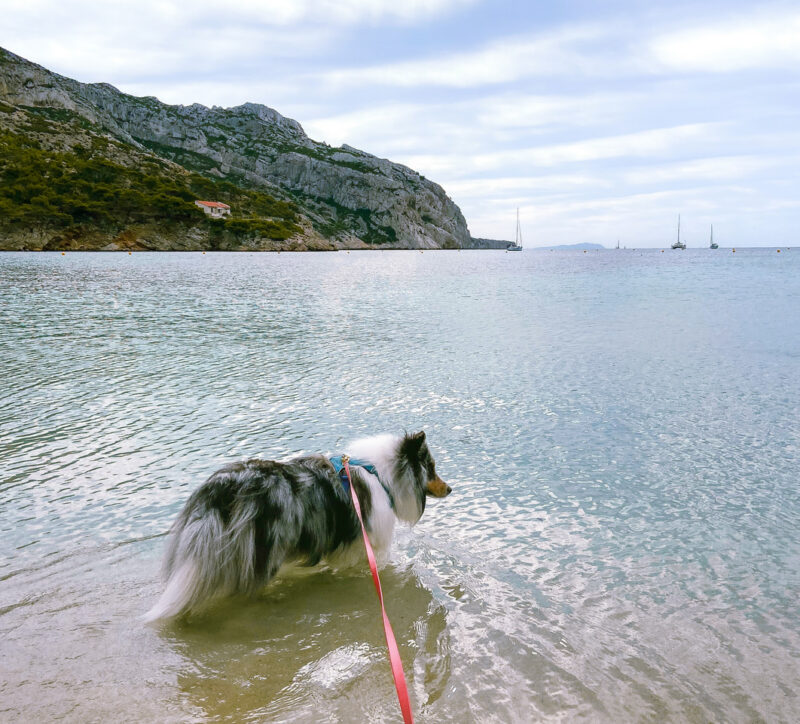
Nova cooling off at Sormiou’s beach. © Chloe Destremau
The beachhead had been cleared and developed just enough for a parking lot, a refreshment bar, and a couple of dirt roads that led to a small port and a street of cabins. There were more homes dotted along the rocky shore, overlooking the inlet. Sormiou is one of the few calanques still inhabited. Made from dry stone, mortar, clay, or sand, the homes were first built for fishermen—recreational anglers, mostly, for only small boats can navigate the shallow water of the cove. But now they are lived by people like you and me. Some have been equipped with solar panels and gas tanks, but otherwise the cabins remain quite rudimentary, with no running water or electricity.
Privilege of this Small Paradise
All who live there understand the privilege of living in this small paradise. Because, as you can imagine, in such a narrow, isolated, and pristine place, there is no construction allowed. If the cliff erodes or some other unfortunate event occurs, and the home crumbles, there is no rebuilding it. That’s it. The cabins can be sold or inherited, but not built. Until nature takes back its own, the locals revel in a threatened lifestyle close to nature, where they get to wake up at the crack of dawn, swim in their crystalline waters, and watch the sunrise over a cup of coffee. What a life to have!

Sormiou ’s port, down one of the dirt roads. © Marseille Tourisme
My favorite trail doesn’t actually go down to the inlet, but stays on the ridge of Morgiou, west of Sormiou. There’s a vista point early on in the trail that allows an uninterrupted view of the inlet, its turquoise water, and the dark patches of its Posidonia seagrass beds.
If you go snorkeling on the southern coast of France, provided you avoid estuaries—the seagrass demands a certain level of salinity to survive—you’ll find Posidonia beds. And within these beds, you’ll find an astonishingly rich biodiversity of fish—like saupes, wrasses, rascasses, algae, cephalopods, mollusks, isopods, echinoderms, and an endless list of other invertebrates.
It makes for great scuba, too. It’s in Sormiou, after all, that the first scuba dives occurred. In 1942, the famous Commander Cousteau, Georges Beuchat, and Albert Falco—two famous French divers—made a historic dive in the Sormiou calanque with new innovative equipment: a compressed-air tank and a regulator, invented by George Commeinhes. The calanques and Marseille’s littoral are deeply rooted in the history of scuba diving in France, and it remains one of the most sought-after activities in the area.

Posidonia oceanica, © GIS Posidonie
Posidonia is perhaps one of the first species I learned about in my Master’s biology course. My professor, before even delving into any of the seagrass’ life history traits, had started a rant about the threat of yachts on the species. To understand the correlation, it helps to know a couple of things about the species’ biology. Posidonia oceanica is endemic to the Mediterranean; it’s not an algae but a flowering plant, an angiosperm. Every four to six years (or three to eleven, depending on who you ask), it blooms, flowers, and produces fruits. The latter are released and drift until they find suitable seeding ground. But Posidonia mainly grows horizontally (without producing fruits), stretching its rhizomes outward, sedimenting a mat for vertical growth. Posidonia does not colonize the ground quickly; it only grows about a meter every hundred years. So when the yachts throw their anchors, my professor explained, and the people aboard don’t mind the seagrass beds, the anchors uproot the mat and tear the rhizomes, effectively destroying millennia worth of growth. Posidonia is among the most important species in the Mediterranean; it behaves much like a forest, providing habitat for species, food sources, hunting and breeding grounds, and acts as a carbon sink, trapping carbon dioxide and producing oxygen in return. My professor had called it a « miracle ecosystem. »
Fortunately, in Sormiou, the grass beds are in rather good condition despite a couple of patches of dead mat here and there. It will recover in time if we continue to leave it alone and protect the area from anchoring malpractice.
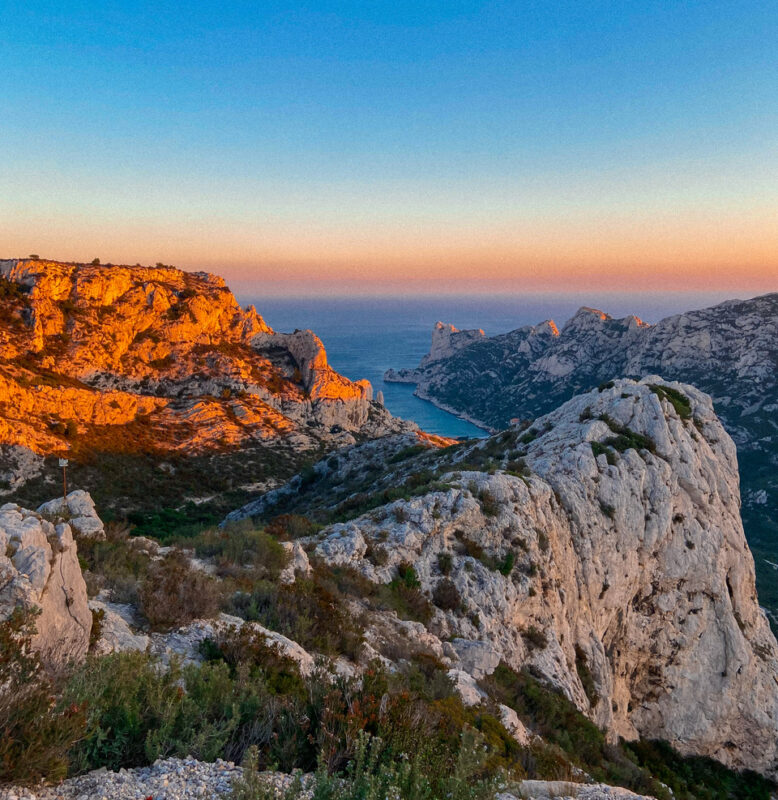
Sormiou, at sunset. © Chloe Destremau
Calanque de Sormiou is singular for many reasons: its wide inlet and beautiful beach, its lush Posidonia and its critters, and its many hiking trails with stunning views. As it is less frequented than other calanques, it allows one to take in the views and feel close to nature.
For me, Sormiou is where I retreated to wash away the noise of the city. I came to learn this place very well. I’ve perhaps not hiked all the trails, covered every surface area possible, or seen it develop over time, but I, shamelessly, have felt a certain sense of belonging paralleling the residents of the cabins, of the Excursionnistes Marseillais, and all those in between that have come to care for this calanque.
 About the writer (photo): Chloé Destremau, pictured with her fur baby Nova hiking the calanque de Sormiou, is a freelance writer and the daughter of Christy Destremau, founder and owner of France Off the Beaten Path Tours.
Ready for your journey to discover the enchanting world of France?
- Check out remaining 2026 tour dates
- Plan ahead, check out our 2027 tour dates
- Contact us at christy@traveloffthebeatenpath.com to request space availability and/or ask questions.
- Message us on WhatsApp at +1.717.683.2827